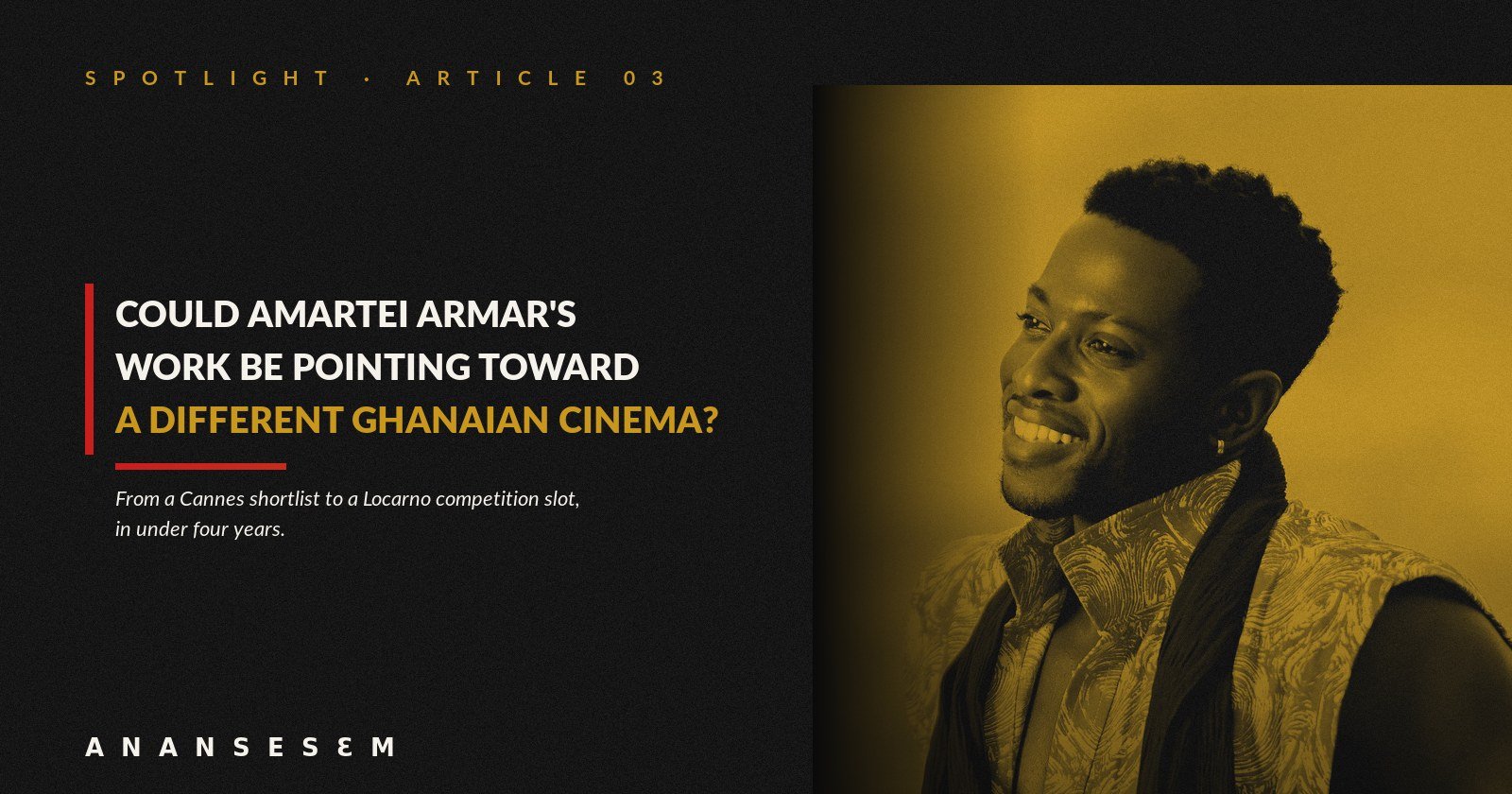
In 2022, a short film called TsutsuƐ became the first film from Ghana, and from Sub-Saharan Africa, to compete in the Cannes Film Festival’s Official Short Film competition. It made the final nine out of more than 3,500 submissions. This year, the same director, Amartei Armar, brings his debut feature to the Locarno Film Festival, where Ego Reach We All competes in Concorso Cineasti del Presente, the festival’s dedicated showcase for first and second features from filmmakers whose work points toward new directions in cinema.
Those are not ordinary milestones, and they did not happen far apart. Within roughly four years, one Ghanaian filmmaker has gone from a Cannes shortlist to a competition premiere at one of the five or six festivals that actually shape which films the world pays attention to. That raises a question worth sitting with before rushing to an answer: is this simply the story of one talented filmmaker having a remarkable run, or is it a sign that a different strand of Ghanaian cinema is beginning to find its audience on the festival circuit?
What Cannes and Locarno Are Actually Looking For
Cannes and Locarno do not select films at random, and they do not select for the same things a Ghanaian cinema audience or a Netflix algorithm selects for. Understanding what got TsutsuƐ and Ego Reach We All through the door says something about the films themselves, and about the gap between festival cinema and the commercial industry Ghana has spent decades trying to rebuild.
TsutsuƐ is set in Teshie, a fishing community on Accra’s coast, and follows two brothers grappling with the loss of their eldest brother, who drowned in waters increasingly fouled by plastic waste. It is a small, specific, place-rooted story about grief and environmental collapse, told through a single family rather than an issue-driven wide shot. Ego Reach We All runs 105 minutes, performed in Twi, Ga and Pidgin, a Ghana-France co-production shot with a Ghanaian cast and crew, backed by the Red Sea Fund, the Fonds Image de la Francophonie, Ane Ventures and Canal+ International as a co-production partner. Locarno’s own description of its Cineasti del Presente section, one of the more important debut platforms in world cinema, says it is built to discover films that suggest where cinema might be heading next, not films that confirm where it already is.
Put together, a pattern shows up: festivals at this level tend to favor specific, character-scaled stories over broad social-issue filmmaking, a slower and more observational pace over the plot density that drives commercial cinema, and a visual and narrative language shaped as much by international arthouse conventions as by local storytelling traditions. None of that means Ghanaian filmmakers should start making films for festival juries instead of Ghanaian audiences. It means the films that travel this particular circuit are, almost by definition, a different creature from the films that fill a cinema in Accra on a Friday night. Armar’s work has found the specific frequency this circuit listens for.
Where Armar’s Work Sits
Armar’s own path helps explain why. He grew up between a Ghanaian father and an African-American mother, split his early years between both cultures, and studied filmmaking at the University of British Columbia, where his thesis short Arc, a triptych about an elderly Kenyan man, a divorced Canadian mother and a Chinese immigrant searching for common ground, picked up awards on the North American festival circuit before he had made a single film in Ghana. In 2017, he moved to Accra. “I’ve come home to stay,” he said at the time. “I read about the dying industry of Ghana on the internet and I would love to be a part of its resurrection.”
That background places him closer to Ghana’s small independent and diaspora-connected filmmaking tradition than to the commercial industry, Ghallywood and Kumawood’s direct-to-video lineage and its more recent streaming-era successors, that most Ghanaians actually watch. His films are foreign-trained, internationally co-produced and festival-facing in a way that commercial Ghanaian cinema, built on fast turnarounds and local distribution deals, generally is not. But he is not working in isolation from Ghana either. TsutsuƐ was shot on the Accra coastline with a Ghanaian cast. Ego Reach We All is performed almost entirely in Ghanaian languages, produced by Yemoh Ike’s Accra-based AKA Entertainment, and scored in part by Ghanaian musician Kweku Sackey. Armar sits, deliberately or not, in the gap between Ghana’s commercial tradition and its almost nonexistent arthouse one: Ghanaian in subject, language and crew, but built and financed through the international festival and co-production system that Ghana’s domestic industry has never really plugged into.
Is This a Pattern, or an Exception?
Here is where the question stops being about Armar and starts being about the ecosystem around him, and it is worth being honest about what the research actually shows rather than what would make the tidiest story.
Armar is not completely without company. Akosua Adoma Owusu, a Ghanaian-American filmmaker who has split her time between Ghana and New York since the mid-2000s, has shown experimental short work at Berlinale, Rotterdam, Locarno and Toronto for close to two decades, including Kwaku Ananse at Berlinale Shorts and White Afro, which won a prize at Locarno in 2019. Anthony Nti, born in Ghana and trained in Belgium, made Da Yie, a Ghana-Belgium short shot on Ghana’s coast, which played more than 130 festivals, won the Grand Prix at Clermont-Ferrand and made the Oscar shortlist. Both are real, sustained careers, and both suggest that Ghanaian-connected filmmakers, usually trained abroad, usually working in short form, usually financed through European co-production structures, have had a working relationship with the international festival circuit for close to twenty years.
What none of them had done, before Armar, was carry that relationship into a feature at a festival on Locarno’s level. Blitz Bazawule’s The Burial of Kojo, Ghana’s most internationally visible feature of the past decade, took a different route entirely: it premiered at Urbanworld, not one of the majors, and reached its audience through Ava DuVernay’s ARRAY and a Netflix deal rather than a festival competition slot. That is a legitimate and arguably more commercially useful path, but it is not the same door Armar just walked through.
So the honest answer is that there is a real, thin pattern of Ghanaian-connected filmmakers reaching the international short film circuit over almost two decades, and Armar’s feature selection at Locarno is less a new data point in that pattern than an escalation of it, the first time it has produced a feature at this level rather than another well-traveled short. Whether that escalation repeats is the actual open question. Are more Ghanaian filmmakers now building work with the festival circuit in mind, the way a generation of Nigerian and South African filmmakers already has? Is there enough international co-production support, the kind of Red Sea Fund and Francophonie money that made Ego Reach We All possible, reaching Ghanaian filmmakers specifically? Do co-productions like this one open a door that other Ghanaian filmmakers without Armar’s Canadian training and international network can actually walk through, or does the door stay narrow? And what does a Locarno premiere actually change for a filmmaker once the festival ends: a sustainable career building on international financing, or a remarkable credit that still has to be converted into what comes next?
One Trajectory, or Something Wider?
None of this diminishes what Armar has done. Getting a short into Cannes’ main competition and a debut feature into Locarno’s competition within a few years of each other is a genuinely rare run, one that very few filmmakers from anywhere manage. But the more interesting question for Ghanaian cinema is not whether Armar is talented. His selections have already answered that.
The question is what his trajectory reveals about where Ghanaian cinema is, and where it might be heading. If filmmakers like Amartei Armar are finding audiences at Cannes and Locarno, what does that mean for the future of Ghanaian cinema? Is this the beginning of a broader movement, one where more Ghanaian stories, told in Ghanaian languages with Ghanaian crews, find their way onto the world’s most selective stages? Or are we still looking at a remarkable individual journey, one filmmaker’s specific combination of training, timing and connections, that the rest of the industry has yet to find a way to follow?