Ask Ghanaian filmmakers what is holding the industry back and the answers tend to arrive one at a time. Funding. Distribution. Audiences. Infrastructure. Each is treated as its own problem, with its own fix.
Underneath many of them sits another problem that is harder to name: fragmentation. Veteran actor Fred Nii Amugi made that case twice in early May. Speaking on GTV’s Breakfast Show on 6 May, he said the unity that once defined the industry is no longer there, and that a divided industry finds it harder to negotiate fair pay, push for policy support or tackle problems such as funding and distribution.
“The strength of any creative industry lies in its people working together. When we stand divided, it affects the quality of our work and how the world sees us.”
On Rainbow Radio 87.5FM the same week, he described a “me or no one” mentality in the acting space and said the Ghana Actors Guild effectively exists only on paper. He was speaking mainly about actors and the bodies meant to represent them. But the diagnosis travels, and it raises a practical question: what could Ghanaian production companies do if, instead of working as separate lanes, they combined what each does best?
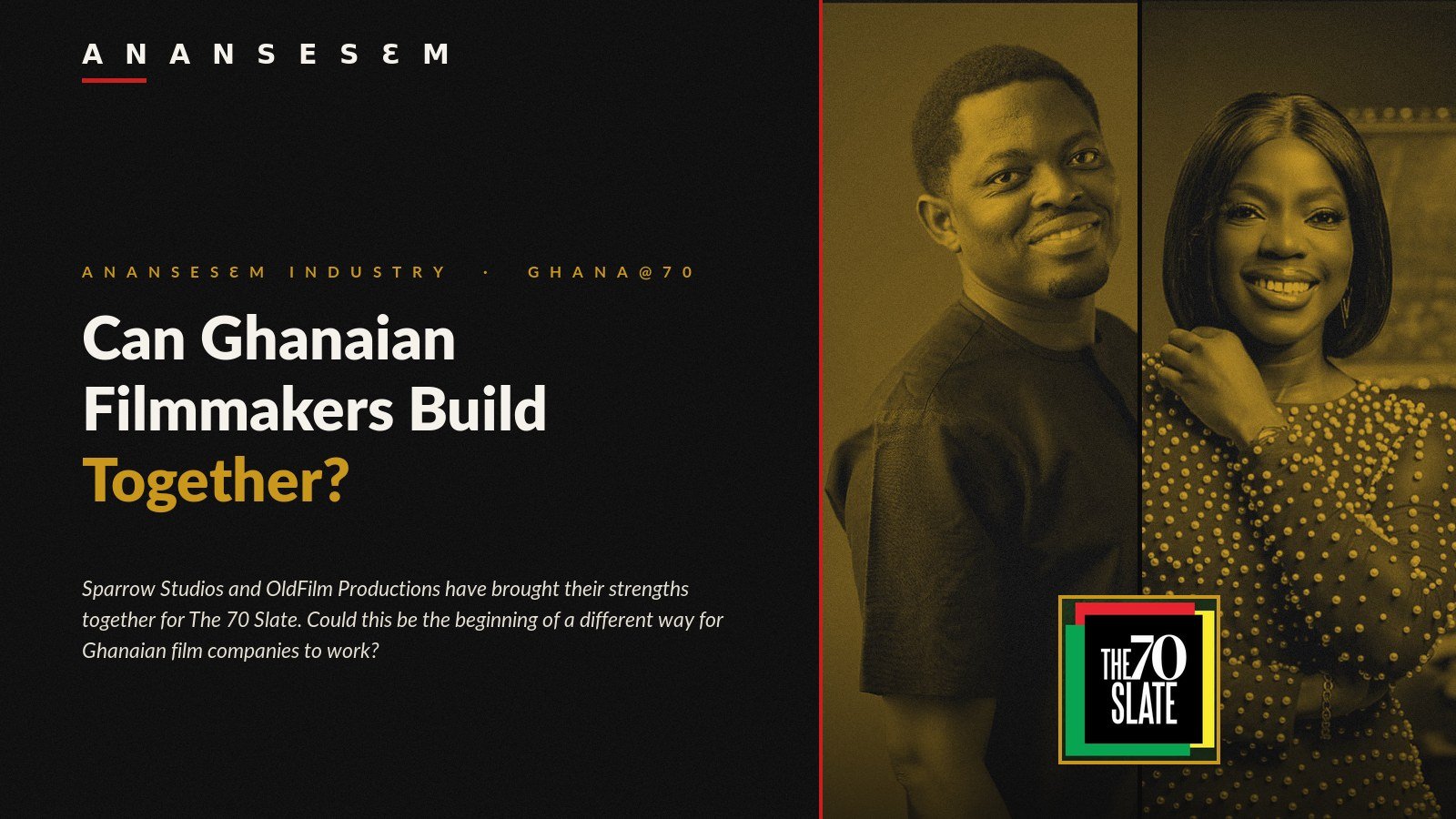
In September, two established production companies put a live example in front of the industry. On 8 September, at the Labadi Beach Hotel in Accra, Sparrow Studios and OldFilm Productions unveiled The 70 Slate, three films for Ghana’s 70th independence anniversary. This article treats the slate as a case study. The question is not whether the films will be good. It is what the arrangement shows about whether collaboration at this scale can work in Ghana.
What Collaboration Makes Possible
The most useful comparison sits next door, and it is useful for a specific reason. The point is not that Nigeria did it and Ghana has not. The point is how it was done.
The Wedding Party (2016) was produced by the ELFIKE Film Collective, a partnership of four Nigerian companies: EbonyLife Films, FilmOne, Inkblot Productions and Koga Studios. Directed by Kemi Adetiba, it was made on a reported budget of ₦60 million. It premiered at the Toronto International Film Festival on 8 September 2016, opened in Nigerian cinemas that December, and grossed roughly ₦450 million at the Nigerian box office. It reached Netflix in August 2017. At the time it was the highest-grossing Nigerian film ever; that record was broken in 2021 by Omo Ghetto: The Saga.
The number is not the point. The structure is. FilmOne, one of the four companies in the collective, is a distributor, and it also distributed the film. A film made by a group that included its own distributor had a route to cinemas inside the partnership, rather than something to be negotiated once the film existed.
That is the question the example raises for Ghana: what does collaboration make possible that an individual production company cannot easily do alone? One film does not make a rule. But it shows what pooling different capabilities, production, distribution and release, can look like when the partners are chosen for what each brings.
Two Companies, Two Shapes
Ghana has companies with real and very different strengths. Two of them are now working together.
Sparrow Studios, led by Shirley Frimpong-Manso, started life as Sparrow Productions in 2003, three years after she graduated from the National Film and Television Institute. Her films and series since then include The Perfect Picture, which won her Best Director at the 2010 Africa Movie Academy Awards, and the ten-part series Adams Apples. The company has built its name on polished, premium drama.
Frimpong-Manso has described the company’s beginnings as uncertain. At the February 2025 launch of Sparrow Station’s YouTube channel, she recalled never knowing whether audiences would leave their homes to see her first feature, Life and Living It, at the National Theatre, one of the few venues in Ghana at the time. The film resonated and established Sparrow in the industry. That same speech set out the company’s ambition: “We strive to share our stories with the world.”
What distinguishes Sparrow is what sits around the titles. For years the company ran Sparrow Station as its own streaming service. That service is no longer running. Sparrow has moved to YouTube, where it has opened a Sparrow Station channel and now uploads its content, a shift Frimpong-Manso described at the launch as the end of 18 years of exploring distribution platforms in search of “the perfect outlet.” YouTube, she said, had been transformed in recent years. The first release on the channel, For Love and Country, starring Lydia Forson, Jackie Appiah and Naa Ashorkor, passed 100,000 views in under three days. Earlier, Potato Potahto had reached Netflix in December 2019. Sparrow is a company that has spent years working on how its films reach audiences, not only on how they are made, and its latest answer is to go where the audience already is.
OldFilm Productions, led by Peter Sedufia, has a different shape. Sedufia graduated from film school in 2015 and, by his own account, his student short The Traveller won three awards, including the Special Jury Prize at FESPACO 2015. His debut feature Keteke (2017), starring Lydia Forson and Adjetey Anang, follows a pregnant woman and her husband who miss the weekly train to her village in the 1980s. Sedufia says it was selected for more than twenty festivals and won seven awards. One of them, a Jury Special Mention at the Khouribja Africa Film Festival in Morocco in December 2018, is documented in press reports. Sidechic Gang and Away Bus followed, then Aloe Vera He also runs The Director’s Call, a workshop series for young filmmakers.
Aloe Vera is the clearest picture of how OldFilm works. Sedufia has said he put more than $235,000 into the film, with financing from Ghana, France and South Africa, and built an entire village set in Dabala in the Volta Region. It premiered at Silverbird Cinemas in Accra on 6 March 2020, and its theatrical run was cut short by the pandemic about a week later. It was later acquired by Netflix and Rok in the United States and, Sedufia says, recouped its investment and made a profit. Keteke and Sidechic Gang had reached Netflix earlier that year.
Both are experienced filmmakers with a distinct voice of their own. Where they differ is in the routes they have built to audiences: Sparrow through its own platforms and distribution, OldFilm through international financing, festival circuits and streaming deals. The slate pairs Sparrow’s polished, premium drama with OldFilm’s flair for storytelling and comedy.
The Problem Both Founders Have Named
What makes the pairing more than a convenient anniversary project is that both founders have spoken, on the record, about the same gap.
In March 2020, as Aloe Vera was reaching audiences, Sedufia said publicly that Ghanaian filmmakers are making strong films, but that the lack of distribution companies to sell them at scale across the world has held the industry back. The only thing filmmakers need, he said, is “someone who calls himself or herself a distributor.”
Five years later, Frimpong-Manso stood at the Labadi Beach Hotel and described her own search. Sparrow, she said, had explored various distribution platforms over 18 years looking for the right outlet, and YouTube in particular had been transformed in recent years.
These are two founders describing the same problem from different positions. One has argued that Ghanaian films need distributors to take them to market. The other has spent nearly two decades building and testing her own routes to audiences. That does not prove the slate is a deliberate attempt to combine the two experiences. It does mean the question is a fair one to ask.
A Wall That Was Already Thin
The two companies’ worlds were never far apart. Lydia Forson led OldFilm’s Keteke in 2017 and starred in Sparrow’s For Love and Country in 2025. Adjetey Anang, who co-led Keteke, is also in the slate’s cast alongside Forson. Even Amugi, whose warning opened this piece, appears in Keteke’s cast as the Old Man.
Shared actors do not make a partnership. But they show an industry small enough that its people already move between companies with different identities and ways of working. The slate is the first time two of those companies have put a shared name to the overlap.
The 70 Slate as a Test Case
The three films are The Return of Makunse, due in December 2026, a drama about migration, broken promises and the illusion of a better life abroad; Nkrumah’s Red, Gold and Green, due in July 2027, which covers the final 24 hours before independence in March 1957; and I Told You So, due in December 2027, a modern remake of a music comedy show. Filming on the first film is already under way.
Behind them is a wider group than the two founders. Frimpong-Manso, Sedufia, Ken Attoh and Araba Sedufia are producers. Dede Chancellor, CEO of Chancellor Productions Africa, and Selassie Ibrahim, CEO of Smartys Production, are executive producers. The project is supported by the National Film Authority, the Ministry of Tourism, Culture and Creative Arts and the Diaspora Affairs Office of the President, and its brand partners include Nestlé Ghana, GLICO and Silverbird Cinemas, the same chain that hosted the Ghanaian premiere of Aloe Vera. The cast includes Fela Makafui, Augustine Abbey, Kojo Boakye, Lydia Forson, Joselyn Dumas, Naa Ashorkor Mensah-Doku, Adjetey Anang, Kwame Dzokoto, Priscilla Ahiable and Araba Sedufia. Casting is still under way.
The idea, as reported, began last year when Sedufia approached Frimpong-Manso. He described his reasoning at the launch: that bringing the two companies’ strengths together “could create something truly special.” Frimpong-Manso said the filmmakers want to reconnect audiences with the cinema experience, and that “global distribution and stronger engagement with Ghanaians in the diaspora are very important to us.”
That last line connects the slate back to the problem this article started with. Distribution is one of the issues the industry most often names, and a founder of this collaboration has made it an explicit goal.
The structure of the slate is also worth reading as a decision. Three films, one contemporary, one historical and one a comedy remake, mean the partnership does not rest on a single story or a single audience. Each film asks something different of the companies behind it. That makes the slate a broader test of the partnership than one film would be.
What Working Together Actually Means
The launch has given us the films, the release calendar, the cast and producer list, and the institutional backing. What sits behind the shared name is the bigger question. Are the two companies sharing financing, infrastructure and distribution relationships? How are responsibilities divided? Could this become a model they repeat beyond Ghana@70?
Those are the details that would turn the slate from a shared banner into a model other companies could study, and they are what we look forward to as the collaboration unfolds and more is made public. For now, The 70 Slate shows two established companies choosing to work together in public.
The Bigger Question
Whether The 70 Slate transfers capability from one company to the other is one question, and the public record cannot settle it yet. The larger question is whether it could be the start of the collaboration culture that at least one of Ghanaian cinema’s veterans says it has lost.
The argument for collaboration is straightforward. Ghanaian companies hold different assets, and some of what the industry says it is missing may already exist inside it, spread across separate companies. Both have years of experience and a distinct voice. One has spent those years testing routes to audiences, from Netflix to its own streaming service to YouTube. The other has taken films through festivals, international financing and streaming deals. The Wedding Party suggests that when companies like these are brought together deliberately, with clear roles, the result can reach further than any one of them would alone.
The first test arrives soon. The Return of Makunse is due in December. What matters beyond its reception is whether the partnership continues, whether it is explained, and whether other companies follow. If the answer to all three is yes, The 70 Slate will have mattered well beyond the anniversary it was made for. That is why it is worth watching long after the celebrations have passed.