

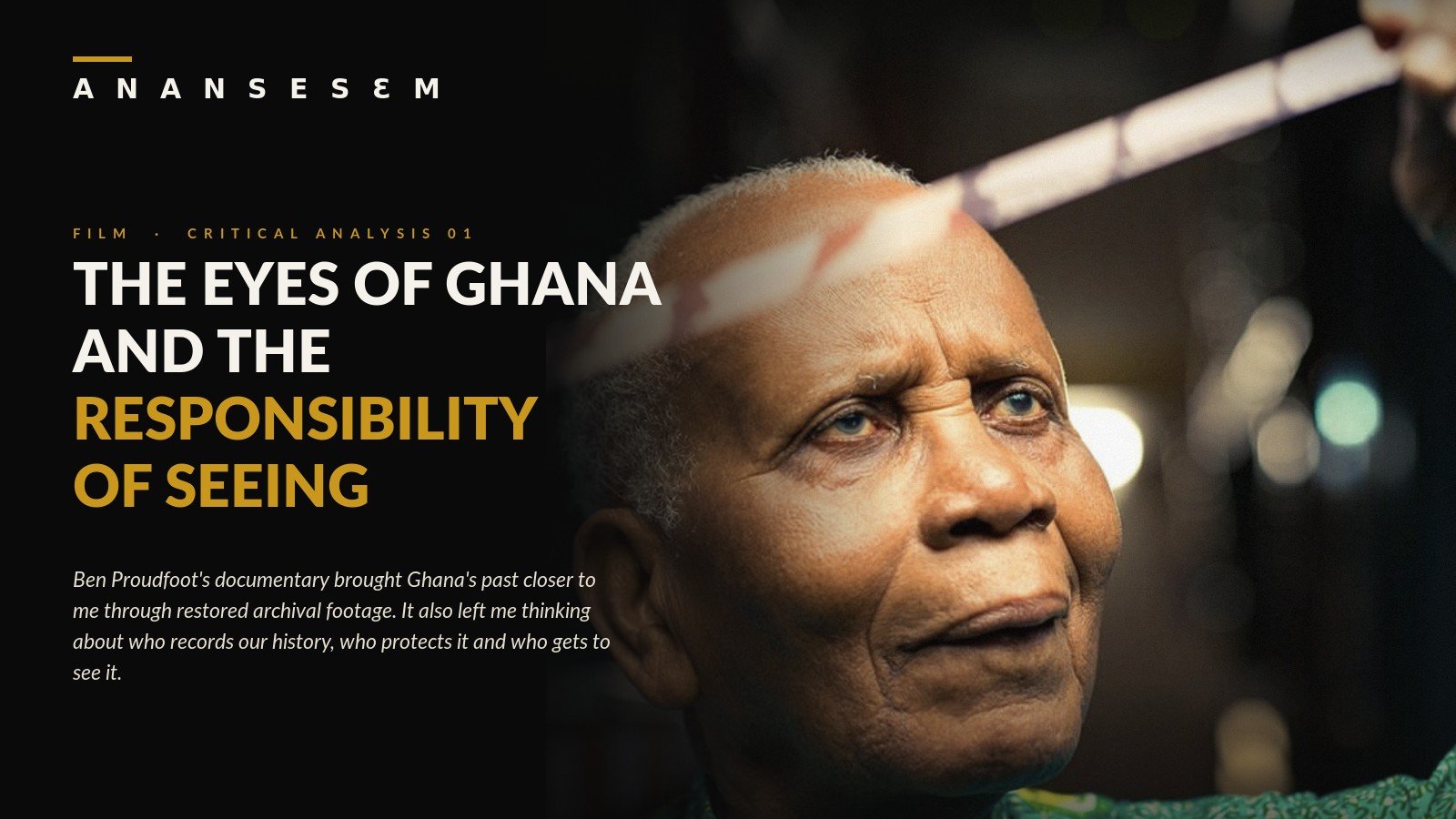
On the images that made me see Nkrumah differently, the people who kept them alive, and what a country owes its cinematic memory.
A Ghana I had been trying to imagine
I thought I knew what Kwame Nkrumah looked like. I knew the photographs that have come to represent him: the public appearances, the crowds, the familiar face of independence. I had read about him, encountered his speeches and watched excerpts of the moving images that have circulated over the years. But there is a difference between knowing a historical figure through the material that has become familiar and watching footage that lets you encounter something of the world around him. The Eyes of Ghana made that difference impossible for me to ignore.
I have been developing a film that takes me back into an earlier period of Ghanaian history. One question keeps returning whenever I think about the world I want to put on screen: what did Ghana actually look and feel like then? Not the Ghana of a carefully chosen photograph, or the period detail assembled for a historical drama. I mean the movement of people in a street, the way a crowd gathers, the faces that appear at the edge of a public occasion, the texture of a place before the Ghana I know existed in its present form. How much of that can I learn, and how much will I be forced to imagine?
Watching the restored footage in Ben Proudfoot’s documentary was therefore an unusual experience. I was responding to the film as a viewer, but I was also looking with the curiosity of someone trying to make a film about the past. I wanted the images to last longer. I wanted to study the backgrounds as much as the subjects, to look again at the people the original cameraman may not have considered central. The material gave me something that historical descriptions alone could not. For a moment, the period was no longer held at the distance of a textbook.
And it changed the way I looked at Nkrumah. I had known the arguments about his ambition for Ghana and for Africa. Seeing him within the life of that moment made me think more seriously about what he hoped the continent could become. I found myself moving from the images to the present, asking what has become of those aspirations. Independence was achieved, but the larger Pan-African promise remains unsettled. Looking at the divisions, inequalities and political difficulties that continue to shape African countries, I felt sadness as well as admiration. Have we fulfilled what that generation imagined? Where have we fallen short? Those are not questions the footage can answer, and they should not turn Nkrumah into a figure beyond criticism. But they are questions I would not have felt in quite the same way without seeing those images move.
That is the opening The Eyes of Ghana creates. It restores more than visual evidence of a period. It restores the possibility of an encounter, and an encounter can unsettle what we thought we knew. The film also asks a harder question, even when it does not always pursue it fully: once the images return, how should we look at them?
The people who kept the past within reach
At the centre of the documentary is Chris Tsui Hesse, the cinematographer who worked closely with Nkrumah and preserved an extraordinary collection of negatives. Those images survived while so much of Ghana’s early film history became difficult to access. The film traces the circumstances that left the negatives in London and the long effort to make them available again. It is tempting to tell this simply as a story of a remarkable man who saved a national treasure. Hesse deserves that recognition. But the fact that so much depended on an individual’s persistence should also trouble us.
The archive belongs to a longer history of filmmaking in Ghana. The Gold Coast Film Unit preceded independence, and Nkrumah’s government understood that film could be part of the work of shaping a national identity. Cinema was a way to show a newly independent country to itself and to the wider world. That ambition mattered. So did the infrastructure and training that made it possible for Ghanaians to work with moving images. Yet the history is complicated from the beginning. Film had also served colonial administration, and state-sponsored images made after independence were still produced within relationships of power. A camera could participate in a project of liberation and remain an instrument of political persuasion.
Hesse’s footage becomes even more precious when we consider the scale of the collection and how little of it most of us have seen. Roughly fifteen minutes of restored material appear in the documentary, drawn from an archive described as containing more than a thousand reels. The distinction is important. Those fifteen minutes are what the documentary shows us, not necessarily the totality of what has ever been restored. I came away overwhelmed by what I had seen and more curious about everything I had not. If that small selection could make me rethink a period I had spent years reading about, what might the rest reveal to filmmakers, historians, students and ordinary Ghanaians?
The question becomes personal through Hesse. Hesse is not presented as a disembodied authority explaining the archive. He is a person with memory, pride, humour and an evident relationship to the work. The story has urgency because the knowledge surrounding these reels is also held in people, and people do not remain with us indefinitely. Preserving film stock matters; preserving the stories that allow us to understand it matters too.
Why the people are as memorable as the footage
What I admire about The Eyes of Ghana is how easily it could have become a solemn history lesson and how consistently it resists that temptation. The people in it are never merely there to supply facts. They are allowed to be funny, stubborn, affectionate and alive. Their personalities are part of the film’s method of storytelling.
I keep thinking about Hesse and Anita Afonu walking at the beach. Anita challenges him about whether he can do press-ups. He attempts them, she is not satisfied with his technique, and she shows him how she thinks they should be done. It is a small exchange. It does not tell us when a reel was shot or explain what happened in 1966. Yet it tells us something essential about the relationship at the heart of this film. There is ease between them. Anita can tease him; he can respond without the weight of his historical importance taking over the scene. The documentary gives them space to exist as people before it asks them to stand for generations of Ghanaian cinema.
I laughed at that moment, and I admired the decision to keep it. Humour can be difficult in a documentary concerned with loss, ageing and the possible disappearance of historical material. Used badly, it can feel like an escape from the subject. Here it grows naturally from the characters. It allows the film to breathe. More importantly, it helps us care about the people doing the difficult work of preservation. We are not simply told that Hesse’s archive matters. We come to understand why the people around him have committed themselves to it.
Anita’s role is important. She is a Ghanaian filmmaker working to recover and protect a cinematic history that her own generation has not been able to encounter fully. Her presence prevents the documentary from becoming a story in which an elderly man recalls an important past while everyone else listens. She is doing something with that inheritance. Her determination gives the film a present-tense purpose. It is also an uncomfortable reflection on film education: how do young Ghanaian filmmakers learn the history of their own craft when so much of the work of earlier generations has remained out of reach?
Edmund Addo brings another perspective. He was a projectionist at the Rex Cinema in Accra and continued looking after the place long after its years as an active exhibition venue. He was not a filmmaker in the same sense as Hesse or Anita. His work was to bring films to audiences, and later to keep faith with a cinema whose public life had faded. Film history is made by cinematographers and directors, but also by projectionists, technicians, exhibitors and people who keep spaces open. Without them, even the most important images can remain unseen.
Hesse, Anita and Edmund are connected by more than their affection for cinema. Each has taken responsibility for a different part of its life: making and protecting images, carrying that work into another generation, and maintaining a place where images can meet the public. Proudfoot’s achievement is to let those connections emerge through their relationships rather than reduce them to symbols. The film can be funny and deeply moving because it understands that history is carried by people who still have ordinary lives.
The beauty of looking closely
I kept thinking about how the film was made. The Eyes of Ghana is carefully photographed, and I was struck by the way it lights Black skin. The faces have shape and depth; the light gives them presence without making them look artificially polished. That attention matters in any film, but it feels especially appropriate here. This is a documentary about a man whose work helped determine how people and a country would be seen. The filmmakers have a responsibility in how they photograph him and those around him now.
The close-ups stayed with me. We spend time with Hesse’s face, including his eyes, and with the expressions of people whose memories carry the story. I did not find the closeness excessive. It gives the interviews a directness that makes them feel personal. There is something quietly affecting about watching a cinematographer who spent much of his life behind the lens become the person we are invited to look at. The attention paid to his eyes also gives the title a visual resonance. These are the eyes through which part of Ghana’s history was recorded, but they are not the only eyes that matter. Anita, Edmund, the people who watched the original films and those of us watching now each see something different.
The sound was another pleasure. I admired how the documentary allows the restored images and the contemporary scenes to feel part of one cinematic experience, rather than treating the archival material as an interruption in a present-day story. Music, voices and the atmosphere of the screening help carry the film’s emotional movement. What impressed me was not simply that the footage looked restored, but that the experience of watching it felt alive. At the Rex, especially, the combination of the images on the screen and the people gathered to see them gives the footage a new social life.
That is why the documentary works beyond its historical importance. A worthwhile subject does not automatically produce a worthwhile film. The choice of characters, the patience to allow humour, the attention to faces and the shaping of sound all determine how we experience the material. The craft is what allows a viewer to feel the stakes of an archive without being given a lecture on why archives matter.
But craft can also make a story persuasive. When we feel close to Hesse, when we enjoy his recollections and are moved by what he protected, we are naturally inclined to trust him. The documentary’s warmth is one of its greatest strengths. It is also the reason the questions surrounding the images deserve careful attention. Admiring the person behind the camera should not prevent us from asking how the camera was used.
What the camera was asked to see
One of Hesse’s recollections provides a way into that difficulty. He describes how Nkrumah could use his walking stick to signal what he wanted filmed. The anecdote is delightful in the telling. It suggests a working relationship built on familiarity, a kind of shorthand between a leader and the man documenting him. It also reveals something important about the nature of the archive. The president was not always a passive subject in front of the lens. He could help determine where it pointed.
The footage is still valuable. It means the images were made within a particular relationship, for particular purposes. A crowd welcoming Nkrumah may tell us something genuine about the excitement of the moment. It may also have been filmed to communicate a vision of national unity and political legitimacy. Both things can be true. The camera records what appears within its frame, but someone has already decided where that frame begins and ends.
Here I wanted the documentary to probe further. I do not need it to put Nkrumah on trial or turn Hesse into a suspect. I do think a film built around such an important archive can ask us to consider the difference between historical footage and an unmediated account of history. Nkrumah’s commitment to Pan-Africanism and his investment in film deserve serious recognition. So do the restrictions on political opposition and the authoritarian aspects of his government. The restored images can help us understand that period, but they cannot resolve its contradictions on their own.
Hesse’s continued work after the 1966 overthrow raises another question. He acknowledges that he carried on working, without giving a detailed explanation of his reasons. I would be uncomfortable treating that fact as evidence that he betrayed Nkrumah or embraced every government that followed. Filmmaking was his profession. People continue to work under political systems they may not support, and a cinematographer employed within a state institution does not automatically share the convictions of everyone who governs it. We do not know enough about his personal motivations to declare them for him.
Yet it is still worth asking what it means to keep filming as governments change. What remains the same about the work, and what changes about the images the state wants produced? Those questions do not undermine Hesse’s achievement. They take his craft seriously. They recognise that the person holding the camera can be a professional, a witness, an artist and an employee, sometimes all at once.
The documentary itself makes choices too. From an enormous collection, its makers select particular images and place them beside interviews, music and present-day scenes. In telling the story of the man behind these photographs, the filmmakers are also interpreting the life he lived and the world he encountered. We should be grateful for the images the documentary allows us to see and curious about those that remain outside it. The distinction matters because the film offers one interpretation of a remarkable life, while the collection holds stories that extend far beyond what any single documentary can tell.
A cinema brought back to life
The film’s movement towards the Rex Cinema brings these ideas together in a way that affected me deeply. Edmund had worked there as a projectionist. Even after the cinema lost much of its life as a place of exhibition, he continued to look after it. He wanted to see the Rex alive again, with a screen that drew people back together. That hope might sound modest beside the ambition of recovering a national archive, but the film shows how closely the two belong.
We watch the space being prepared: the clearing, the repairs, the painting and the work needed to make a screening possible. Then people arrive. The place that Edmund had spent so long caring for fills with an audience, and footage from Hesse’s work is projected there. I found that sequence extraordinarily moving. It is one thing to know that film survives in a vault or has been transferred into a digital file. It is another to watch people gather in Ghana to see images of their own history on a cinema screen.
What makes the moment powerful is that it fulfills something for both men. Edmund gets to see the Rex functioning as a cinema again, the wish he had carried through years of looking after it. Hesse gets to see his images brought back into public view after so much effort to preserve them. Their work meets in that space. The cameraman’s footage finds an audience; the projectionist’s cinema has something to show. For me, this is the emotional centre of the documentary.
The version of the film I watched also confirms that Edmund unfortunately passed in 2026. Knowing that he was able to witness the Rex alive again before his death gives the sequence a different weight. It is a joyful ending to a long personal hope, and a reminder of how much our film heritage has depended on people who cannot keep waiting forever for institutions to act. The film cannot bring back the years in which the Rex stood underused. It can show that his care for the place was not meaningless.
I do not want to diminish that achievement by immediately asking whether the Rex will remain active. The night matters in its own right. But it also demonstrates what is possible when preservation and exhibition meet. A cinema is more than a building with a screen, just as an archive is more than reels kept safe. Both need people, resources and continuity. The question after the applause is whether we can build conditions in which moments like this become part of our film culture rather than rare exceptions.
What the other images might give us
I keep returning to those fifteen minutes. The footage in the documentary gave me an experience of Ghana’s past that years of familiar images and historical reading had not quite provided. It made Nkrumah more present to me, while also leaving me with more questions about his ambitions and their legacy. It gave me details to think about as a filmmaker and a renewed awareness of how much we have yet to see. And it made me think of the generations of Ghanaian filmmakers who might have learned differently if this work had been accessible to them all along.
So what might the remaining material contain? I do not ask because I expect a hidden reel to settle every historical debate. It will not. The footage was made through particular eyes, under particular conditions, and it will have its own absences. I ask because even those limits are worth studying. The people outside the centre of the frame, the ordinary details caught alongside official events, the things a cameraman intended to show and the things he recorded without realising their future significance may all become valuable to someone looking at the past from another generation.
There have been announcements about archival retrieval and digitisation, and I hope the work continues. But the measure of success cannot be an announcement alone. We need to know what has been preserved, how the originals will be protected, how the material will be catalogued, and whether students, historians, filmmakers and the public can meaningfully access it. Restoration is painstaking work, and not every reel can be made available at once. That is all the more reason to think about preservation as a sustained responsibility rather than a single celebration.
For years, conversations about Ghanaian cinema have understandably focused on the films we are trying to make now: how to finance them, where to screen them, and how to find audiences. The Eyes of Ghana reminded me that the future of our cinema also depends on our relationship with the work already made. We cannot build a complete understanding of our film culture if each generation is forced to begin as though the one before it left nothing behind.
I went into the documentary wanting to see an earlier Ghana. I came away having seen something of it, having laughed with the people who helped preserve it, and having watched an old cinema fill again with the life it was built for. I also came away less willing to treat historical images as simple windows. They are made by people, shaped by power, protected through care, and given new meaning by the audiences who encounter them.
That, to me, is the responsibility of seeing. We can be moved by the beauty of these images and still ask who made them and why. We can admire Nkrumah’s vision without denying the difficult parts of his political history. We can celebrate Hesse, Anita and Edmund without assuming that their personal dedication is an adequate national preservation system. And we can be grateful for the footage the documentary gives us while insisting that the rest deserves a future too.
Fifteen minutes of restored archival footage made me see Ghana differently. I want to know what the others might teach us.