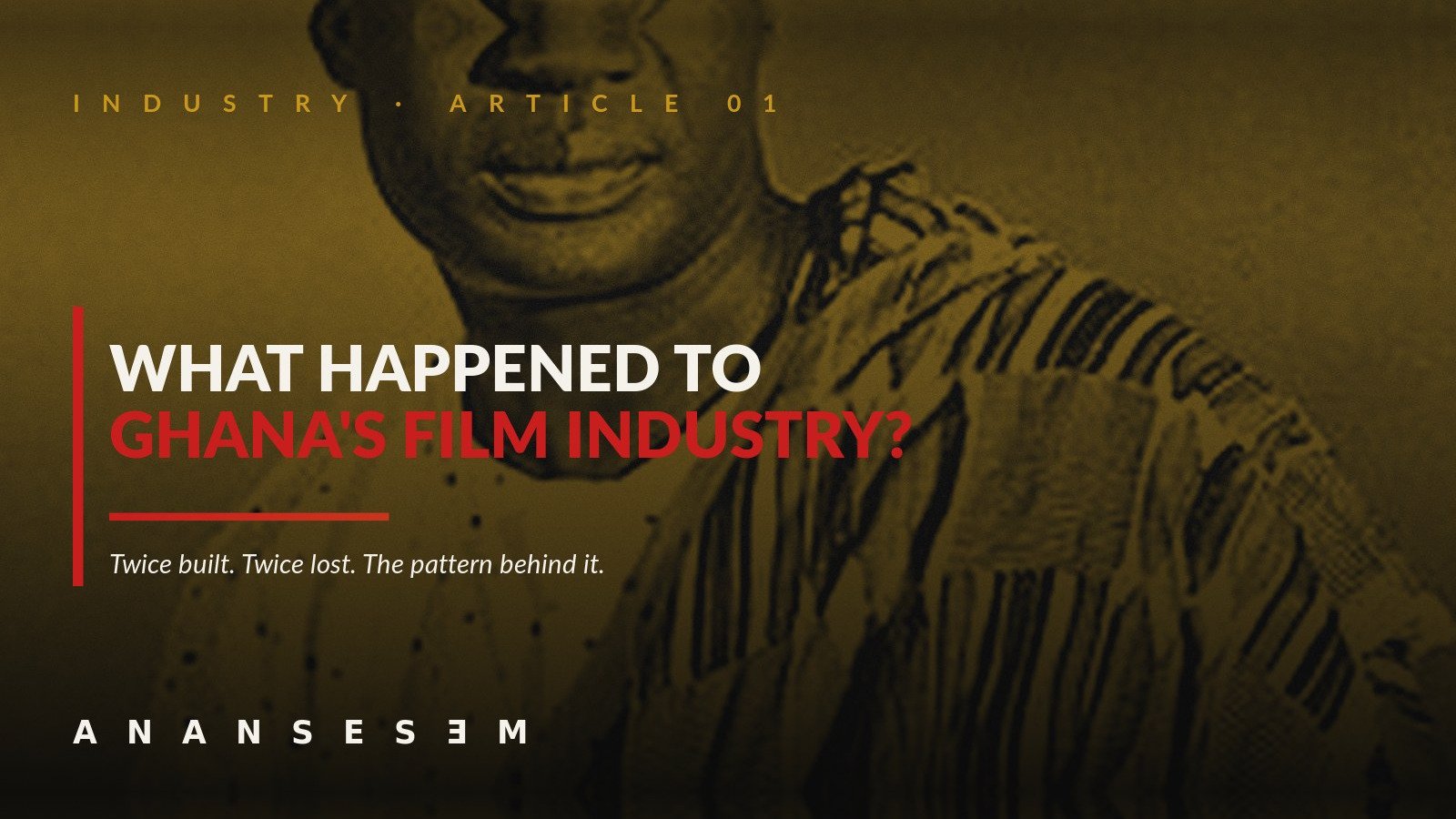
Twice, Ghana built something that worked. Twice, it lost the ground under that success before building whatever was supposed to come next. This is that pattern, and the question of whether it’s about to repeat itself again.
“What happened to Ghana’s film industry?” usually gets asked like an accusation, one where the answer is assumed to be simple decline, or worse, that the talent was never really there.
It wasn’t a talent problem. Ghana ran one of the best-equipped film studios on the continent. A Ghanaian filmmaker won Africa’s most prestigious festival prize before almost anyone else did. A home-video boom put local films in more households than the cinema era ever managed. Twice, something here worked. Twice, it stopped working, and nothing built to last replaced it. That’s the pattern actually worth understanding, more than any single villain or verdict.
The Studio Nkrumah Built
Ghana’s industry began as government policy, not private ambition. When Kwame Nkrumah took over the Gold Coast Film Unit at independence in 1957, he spent £275,000 acquiring West African Pictures Ltd and rebuilt it into the Ghana Film Industry Corporation, reportedly home to the largest soundstage in Africa. For Nkrumah, film was a nation-building project, a way to hand Ghanaians a version of themselves that colonial cinema had never bothered to offer.
It worked for about a decade. Then the 1966 coup ended more than a presidency. It ended the state’s appetite for funding an expensive prestige studio, and GFIC never recovered the momentum, or the money, behind it.
Proof the Talent Was Never the Issue
The clearest evidence against a talent shortage arrived decades after that collapse, not before it. In 1989, Kwaw Ansah’s Heritage Africa won the Étalon de Yennenga, FESPACO’s top prize, becoming the first English-language African film to take it. It also picked up honors from the Organization of African Unity and the London Film Festival that same year.
Ansah made it independently, with none of the state infrastructure Nkrumah had built a generation earlier. Ghana’s biggest cinematic achievement happened outside the system meant to produce it.
The Video Boom That Replaced Cinema
Two years earlier, William Akuffo had already reshaped the industry’s future more permanently than any prize could. Unable to afford film stock, he shot Zinabu on video in the mid-1980s and released it in 1987, the same year a government ban on video was lifted, partly because of the case he made against it.
The film set off a genuine boom. Cheap, self-financed video productions, distributed on VHS and later VCDs, sold directly into markets. Accra’s English-language wing became known as Ghallywood. Kumasi’s Twi-language counterpart, Kumawood, ran at even higher volume, reportedly close to four films a week by the mid-2010s.
At the same time, Ghana’s old cinema halls, the Rex, the Orion, the Regal among them, emptied out. Once people owned a television and a video deck, there was less reason to leave the house. The halls became churches and storerooms. This wasn’t simple decline, though. Ghana traded one distribution channel for another. The industry moved. It didn’t die.
Then the Video Industry Collapsed Too
Piracy and the smartphone did to VCDs what VCDs had done to the cinema hall. Nigeria’s Nollywood hit the identical wall and kept moving, because it had built more than one place to land: theatrical cinema, growing festival recognition, and eventually YouTube, where actresses like Bimbo Ademoye and Ruth Kadiri turned personal channels into profitable studios with millions of subscribers, no streamer required.
Ghana built fewer landing spots. Cinema infrastructure never recovered its old scale: just 18 screens across seven locations nationwide as of 2024, for a country of roughly 34 million people. A Ghanaian YouTube-first economy is only starting to take shape. Shirley Frimpong-Manso’s Sparrow Station, launched in March 2025, is an early, promising example. It’s one filmmaker, not yet an ecosystem.
Who Reinvests, and What’s Being Tried Now
Underneath the platform question sits a people question: who reinvests? In Nigeria, enough stars became producers to keep capital moving through the industry. In Ghana, that’s happened less consistently, partly because the incentives were never really there. Without reliable distribution, funding a film has long been a hard business case to make twice.
Ghana’s National Film Authority, established in 2016, is trying to change that math. In 2024, it issued its first production grants, roughly $96,000 across three projects. In May 2026, it launched something bigger: a Film Development Fund, seeded with a GH₵20 million government commitment, designed to work as a revolving fund rather than a one-time handout.
Whether that holds depends entirely on whether distribution gets fixed alongside it. A fund that finances films nobody can profitably release just recreates the old trap with better paperwork.
The Real Question
Ghana’s pattern isn’t decline. It’s closer to amnesia: build something that works, lose the ground under it, take too long building what comes next. It happened in 1966. It happened again when VCDs gave way to digital.
Heritage Africa already answered whether Ghana has the talent. The real question is whether this time, something finally gets built that’s still standing the next time the ground move.