Ghana’s Been Here Before, Just Not Like This.
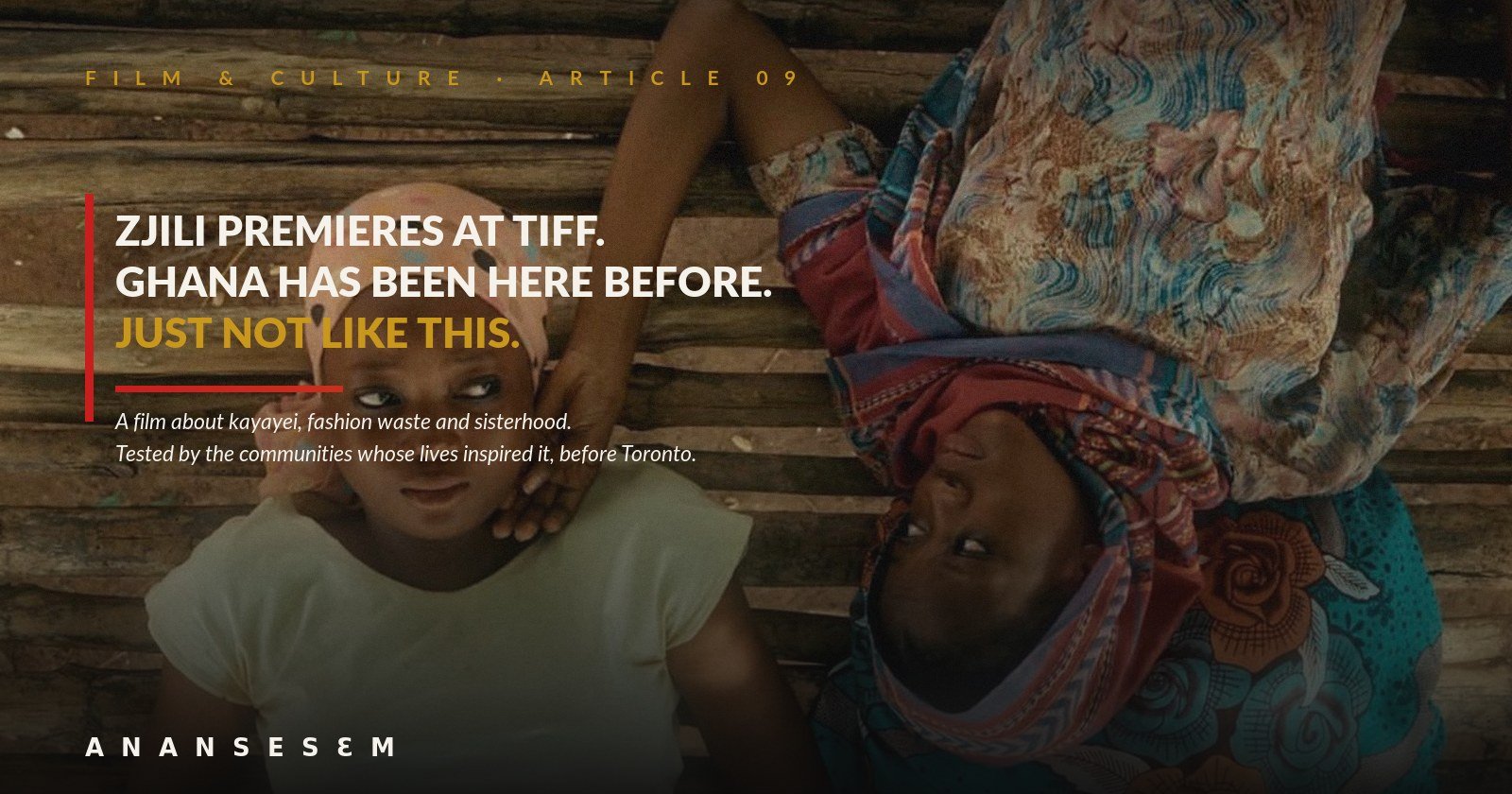
Later this month, a Ghanaian film will step onto one of the biggest stages in the world. Zjili: A Story of Sisterhood and the Burdens of Excess has its world premiere in the Discovery programme at the Toronto International Film Festival, one of ten African productions and the only Ghanaian one in this year’s TIFF lineup.
If that sentence sounds familiar, it should. Ghana has stood on this stage before. Akosua Adoma Owusu’s Kwaku Ananse had its North American premiere at TIFF in 2013. Amma Asante, born in London to Ghanaian parents, brought A United Kingdom to the festival in 2016. Just last year, Shirley Frimpong-Manso’s Stitches showed up in TIFF’s Industry Selects sidebar, a smaller strand built for buyers rather than festival audiences.
What’s worth paying attention to this time is who made Zjili, and in what order things happened before it reached Toronto.
A kayayo named Zoya
Zjili follows Zoya, a fictional kayayo, a female head porter, who leaves a village in northern Ghana for Accra and starts carrying bales of secondhand clothing through Kantamanto Market, one of the largest secondhand clothing markets in the world. The story is not one woman’s biography. It was built from a composite of testimony gathered across many real kayayei, the women who carry bales weighing up to 120 pounds for as little as fifty cents to a dollar a trip.
TIFF’s own program copy describes the film as being about “sisterhood and the weight of social expectations through a distinctly Ghanaian lens,” language that is noticeably softer than how the film’s own producing organization describes it. The Or Foundation, the Ghana and U.S. based non-profit behind the film, is explicit that Zjili is about kayayei labor and the fashion waste economy that depends on it, not sisterhood in the abstract. That gap between the festival’s framing and the film’s actual subject is worth noticing on its own. It says something about how a very specific, very local story gets described once it starts traveling.
One detail from the film is hard to shake. Its climax includes a scene, built from something that happened without a script, in which a group of kayayei realize together that they need to form a union to stop retailers from pricing them against each other. It plays as fiction. It didn’t start as one.
The filmmaker and the fixer
Here is the part of Zjili’s story that doesn’t get said out loud in any of the coverage so far: its two credited directors are not filmmaking peers.
Christine Boateng is a trained director and photographer, a 2019 alumna of the MultiChoice Talent Factory Academy with credentials from Nairobi’s Africa Digital Media Institute and a film and TV production certificate from the University of Ghana. She has produced screen work before, including the 2022 documentary short Ampe: Leap into the Sky, Black Girl. Inside The Or Foundation, her staff title is Story Producer.
Hajara Musah Chambas, who goes by Nabia, has no such background. She is The Or Foundation’s Kayayei Outreach and Education Manager, a role built on development education and participatory research in the rural communities of northern Ghana that kayayei migrate from. Nothing in her public record, before Zjili, points to filmmaking. What it points to instead is proximity. Of the two directors, she is the one with the longest, closest relationship to the actual women whose lives became Zoya’s.
Put plainly: one director was trained to make films. The other was trusted by the community the film is about. TIFF and the film’s other public credits list them as equal co-directors, which raises a real question rather than answering one. What does authorship mean when it’s split this way?
An organization that already had everything but a movie
Zjili did not appear out of nowhere. The Or Foundation, founded by Liz Ricketts and Branson Skinner, has spent years building the infrastructure this film draws on. A 2021 chiropractic study of one hundred kayayei documented spinal damage consistent with car accident trauma in girls as young as twelve. The Aisha Adam Mabilgu Scholarship, named for a kayayo killed carrying a bale near Kantamanto’s rail line, funds university education for women trying to leave head carrying behind. An apprenticeship program teaches trades. A solidarity fund has paid out more than half a million dollars to market workers since 2020. After a fire destroyed ten of Kantamanto’s thirteen sections on New Year’s Day 2025, the Foundation committed a million dollars in emergency relief.
By the time Zjili went into development, in other words, The Or Foundation already had the research, the relationships, and the reach. What it didn’t have was a film. Cinema is the newest addition to a toolkit that already included health science, scholarships, and a workforce development program, which raises its own question: what does a feature film accomplish that a decade of research reports and news placements couldn’t?
It already had a premiere
Before Toronto, Zjili had another audience, and that audience came first.
In February 2026, the filmmakers held beta screenings in northern Ghana, in the communities many kayayei migrate from. Viewers were reportedly shaken by how much they hadn’t known about what awaits daughters and sisters who go south. A separate screening in Accra, for kayayei only, produced a different kind of reaction: crying, gasping, a room talking over itself. A kayayo named Mohammed Arahamatu, ten years into the work, stood up afterward and spoke about how closely the film matched her own life, days after injuring her leg carrying a bale.
“This film is not just a movie. It’s a true story of us. It touches everyone’s story.”
Huzeima Hafiz, former kayayo and Or Foundation staff member, on Zjili
That unscripted union scene did what fiction rarely gets credit for doing in real time: it made people in the room ask why they weren’t doing the thing they’d just watched. Several women reportedly asked, after the screening, why they shouldn’t organize for real.
By the time TIFF audiences see Zjili in September, in other words, they will be its second audience, not its first. That ordering is unusual enough to matter on its own.
What Toronto is actually offering
TIFF’s Discovery programme has a genuinely strong track record. Past selections went on to include Alfonso Cuaron, Christopher Nolan, Ildiko Enyedi, and Barry Jenkins, among others, and this year’s slate runs twenty four features chosen by a ten person curatorial panel. That history is real, and it means something for two first time feature directors from Ghana to be included in it.
It is worth being precise about what it means, though. A Discovery slot is an opening, a credible signal that programmers believed in the voice behind the film. It is not a guarantee of distribution, acclaim, or even much press attention, since most Discovery titles pass through a festival run without either. No Ghana theatrical release, distributor, or sales agent has been announced for Zjili as of this writing. The Or Foundation has said it wants the film to reach three audiences: the Accra market employers who hire kayayei, the northern families who send daughters south without knowing what awaits them, and the Global North whose discarded clothing feeds the entire system. A Toronto premiere reaches the third of those audiences most easily. Whether it reaches the other two is still an open question, and one worth returning to after the festival.
Almost everything written about Zjili so far, including the most detailed account of its making, has come from outlets and voices with existing ties to The Or Foundation itself. TIFF will likely be the first time the film is seen by anyone with no prior stake in how its story gets told.
Just not like this
Ghana has been on this stage before, and it will be again. What’s different this time is a film that was tested by the women it’s about before it was tested by anyone else, made by a pairing that splits cleanly down the middle between craft and access, produced by an organization that had built almost everything else, a health study, a scholarship, a market rebuilding campaign, before it built a movie.
Zjili premieres in Toronto this month. What happens after that, whether it reaches Kantamanto the way it reached Accra and the north first, is the part of the story still being written.