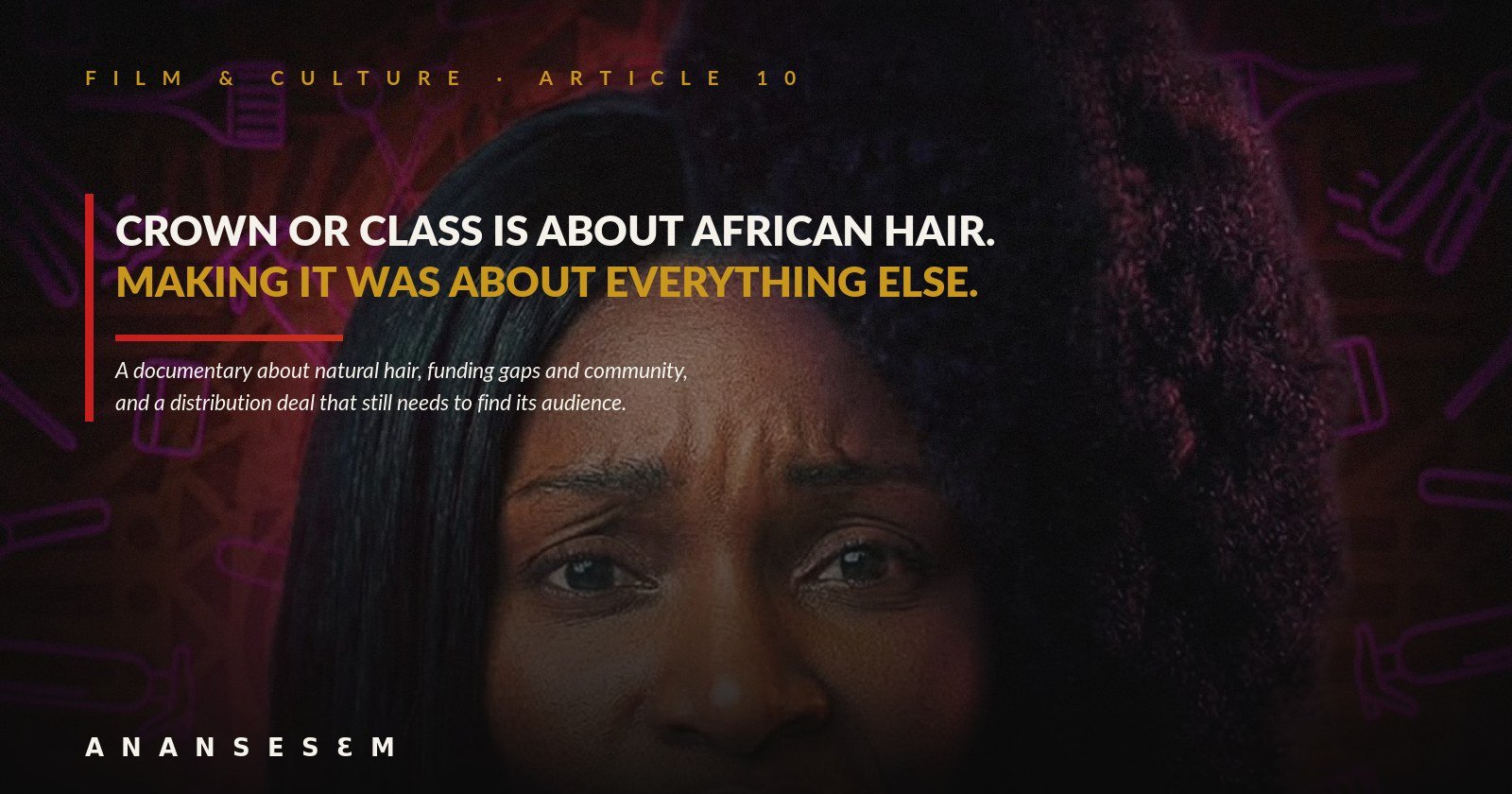
A new documentary asks what African women do with their natural hair. The bigger story is how an independent film like it actually gets made, financed, and carried to an audience without a studio behind it.
Crown or Class opens on a simple premise: two young African women, one in Ghana, one in Belgium, and what they choose to do with their hair. That is the film’s entry point, and it is a real one. It is not, in the end, the most interesting thing about the film.
The more interesting thing is what it took to make it. Crown or Class was shot across five countries by a Ghanaian filmmaker on his first documentary, turned down by a Flemish public film fund at the final stage, brought in short of its crowdfunding target, and finished on money the production’s own executive producers put in themselves. It was produced by a small crew of Ghanaian and diaspora filmmakers, several of whom met at the same film school, and is now, more than a year after release, working its way through a patchwork of diaspora film festivals in a shorter cut built for that circuit, while a longer cut carries a global VOD, TVOD, and SVOD distribution deal. That journey, more than the finished film alone, is what this piece is about.
Eighteen contributors, five countries, two cuts
Crown or Class exists in two forms: a one hour and fourteen minute cut and a 29 minute and 59 second cut built for festivals. It draws on more than 18 credited contributors gathered across Belgium, the Netherlands, Germany, the United Kingdom, and Ghana: historians, hairstylists, a dermatologist, a trichologist, a Pan-African linguist, a sculptor, a natural-hair therapist, a former Ghana’s Most Beautiful runner-up, and human- and synthetic-hair retailers among them. Its argument, built from their testimony, is that the pressure African women feel to straighten, relax, or cover natural hair traces directly back to colonial-era beauty standards that never fully left.
Two of its credited voices state that argument plainly. “Embracing our own takes us away from unrealistic standards,” says Kwame Akoto-Bamfo, the sculptor and founder of Accra’s Nkyinkyim Museum. “No matter how much or how long you perm your hair, you are not going to be white or European.” Professor Ọbádélé Bakari Kambon, a University of Ghana linguist, is blunter still: “If you want to understand any problem, don’t look at who suffers, look at who benefits. The same ones who said your natural hair is bad profit when you buy the chemicals, wigs, and weaves. They laugh all the way to the bank.”
That is the film’s core argument. Less visible, and more interesting, is the process behind it: how a film like this actually gets made.
From commercial work to a first documentary
The director, Kwaku Agyekum Sikahene-Adarkwa, who works under the name Kaay DiFilmer, trained in film directing at Ghana’s National Film and Television Institute before settling in Belgium, where he co-founded Wuku Studios. Before Crown or Class, his credited work was mostly corporate and branded: commercials for Barclays Ghana, Guinness Ghana, and Burger King Ghana, and television editing on TV3’s Ghana’s Most Beautiful pageant. Crown or Class is his first documentary aimed at an international festival audience.
He has described the motivation as personal rather than professional. In a December 2024 interview, given while the film was still fundraising, he pointed to the women in his own life, his mother, aunties, sister, wife, and daughter, each navigating their hair differently, and called the film his attempt “to reconcile my own feelings about the pressures and expectations surrounding beauty.” He built much of the film’s interview list through his own network, including a partnership with the Ghana Council of Belgium to identify subjects in the diaspora.
He did not make it alone. The poster credits a co-director and co-producer, Noah Komla Sedode, who currently serves in the British Army as a personnel administrator and studied film editing at the same school as Sikahene-Adarkwa; two editors; four executive producers; three associate producers, including the actor and author Dayan Kodua; a dedicated composer; and a four-person camera team led by cinematographer Alex Ahenfo. It is a small, independently assembled production, built around Sikahene-Adarkwa’s own network and a compact crew covering camera, editing, and production roles across five countries.
Piecing together the budget
Before the crowdfunding, there was a pitch. The production submitted Crown or Class to the VAF (Vlaams Audiovisueel Fonds), the public film fund for Flanders, Belgium, and was dropped at the final stage. The production’s own read on that rejection is straightforward: a film built around African women, they believe, was always going to register as more valuable to an African audience than a Flemish one, and that counted against it in the room where the decision got made.
The film was then crowdfunded through Seed&Spark starting in late 2024, while Sikahene-Adarkwa described funding as the project’s single biggest obstacle. The campaign did not reach its target. An earlier listing for the film on a Cannes-adjacent sales platform names two additional backers: it states that “the Ghana Council of Belgium and Sankaa have pledged financial support,” alongside promotion on their platforms.
With a public fund pass and a crowdfunding shortfall behind it, the production closed the remaining gap on money its own team of executive producers put in themselves. None of that is unusual for a film at this scale. What it does make clear is where a five-country shoot’s money actually came from once the institutional and crowdfunding routes didn’t fully deliver: not a studio, not a fund, but the production’s own executive producers underwriting the difference themselves.
Shooting across five countries on a small crew
Production began in March 2025 across Belgium, the Netherlands, Germany, the United Kingdom, and Ghana. Coordinating a shoot across five countries and two continents on an independently financed budget is its own logistical story.
What is public is the model. Sikahene-Adarkwa and Sedode’s own footage and community connections, in Ghana, in Belgium, in the UK, in Germany, in the Netherlands, were paired with subjects reached partly through the Ghana Council of Belgium’s own network. That is a real, if unglamorous, way to build a documentary without a studio behind it: relationships doing the work a production budget would otherwise have to do.
A network that already believed in the subject
By the time Crown or Class started collecting festival selections, it had already built its credibility inside a fairly specific circle. Professor Kambon, quoted above, is also a co-founder of the Abibitumi Abibifahodie Film Festival in Accra, one of the four festivals credited with selecting the film. Kwame Akoto-Bamfo’s own public work at the Nkyinkyim Museum explicitly addresses reclaiming natural hair as part of a broader project of reclaiming stigmatized traditions. Grassroots Pan-African filmmaking in Accra runs substantially on relationships like these, and the credibility they lend a first-time documentary is real. So far, Crown or Class has been validated largely from inside a network already invested in its subject; whether it finds traction with programmers and critics outside that circle is the next stage of its journey.
Checking the festival record
Crown or Class has four festival selections and one honorable mention to its name, all built around the 30-minute cut made for exactly this circuit. Checked one at a time, the record holds up, with a few distinctions worth stating clearly. Its African Diaspora Cinema Festival screening, at NYU’s Villa La Pietra campus in Florence, is part of a real, recurring series. Its Abibitumi Abibifahodie Film Festival selection is real and current, run out of Accra’s Ozone Cinema. Its honorable mention “at the Africa USA International Film Festival in Cannes, France” is a real credit, from a festival that runs an independent parallel program in the town of Cannes during the Cannes Film Festival’s own dates, distinct from the Cannes Film Festival itself. Its Charlotte Black Film Festival and Rivers International Film Festival selections sit further outside the public program record, smaller festivals whose archives are harder to trace independently.
Getting from a distribution deal to an audience
In July 2026, the production announced a “global distribution” agreement with Gravel Road Distribution Group, a real and established Cape Town company that handles African-market sales and has distributed titles including The Boy and the Heron theatrically in South Africa. That is a credible, checkable relationship, and its terms are now clearer than they were: the deal covers the full digital package, VOD, TVOD, and SVOD, worldwide, built around the 74-minute cut. Which specific platforms it actually lands on is still being worked out by the sales team; the production says it’s hoping for a place in Netflix’s “Made for Africa” strand, though that placement is not confirmed.
The scope of the deal is settled; where it actually lands is not. The entire premise of a documentary aimed, in its director’s own words, at educating “the much younger generation of women” depends on the film reaching a platform African audiences actually use, not just on the rights existing on paper. A place on a major SVOD service’s Africa-facing slate would do that. A narrower, more festival-facing rollout, however global the paperwork, would not reach nearly as far. Which of those Crown or Class becomes is still being decided, and the production expects to hear from its sales team soon.
The bigger question
Crown or Class is not the first Ghanaian film to use hair as a way into questions of colonialism and identity. Akosua Adoma Owusu’s Me Broni Ba, a lyrical short shot in Kumasi’s hair salons in 2009, worked the same terrain nearly two decades earlier, and Owusu went on to premiere Kwaku Ananse at TIFF in 2013. Internationally, the natural-hair documentary is its own well-established genre, running from Chris Rock’s Good Hair in 2009 through Back to Natural in 2019.
What Crown or Class adds is not a new question about hair. It is a specific, unglamorous answer to a different one: what it actually takes, in money nobody fully accounts for, a public fund’s pass, a crowdfunding target missed, relationships that substitute for budget, and small crews doing several jobs each, for an independent Pan-African documentary with no studio and no festival pedigree behind it to get made at all, and how much of that work stays invisible even after the film starts moving through the world.
That, more than either cut of the finished film, is the story worth watching.