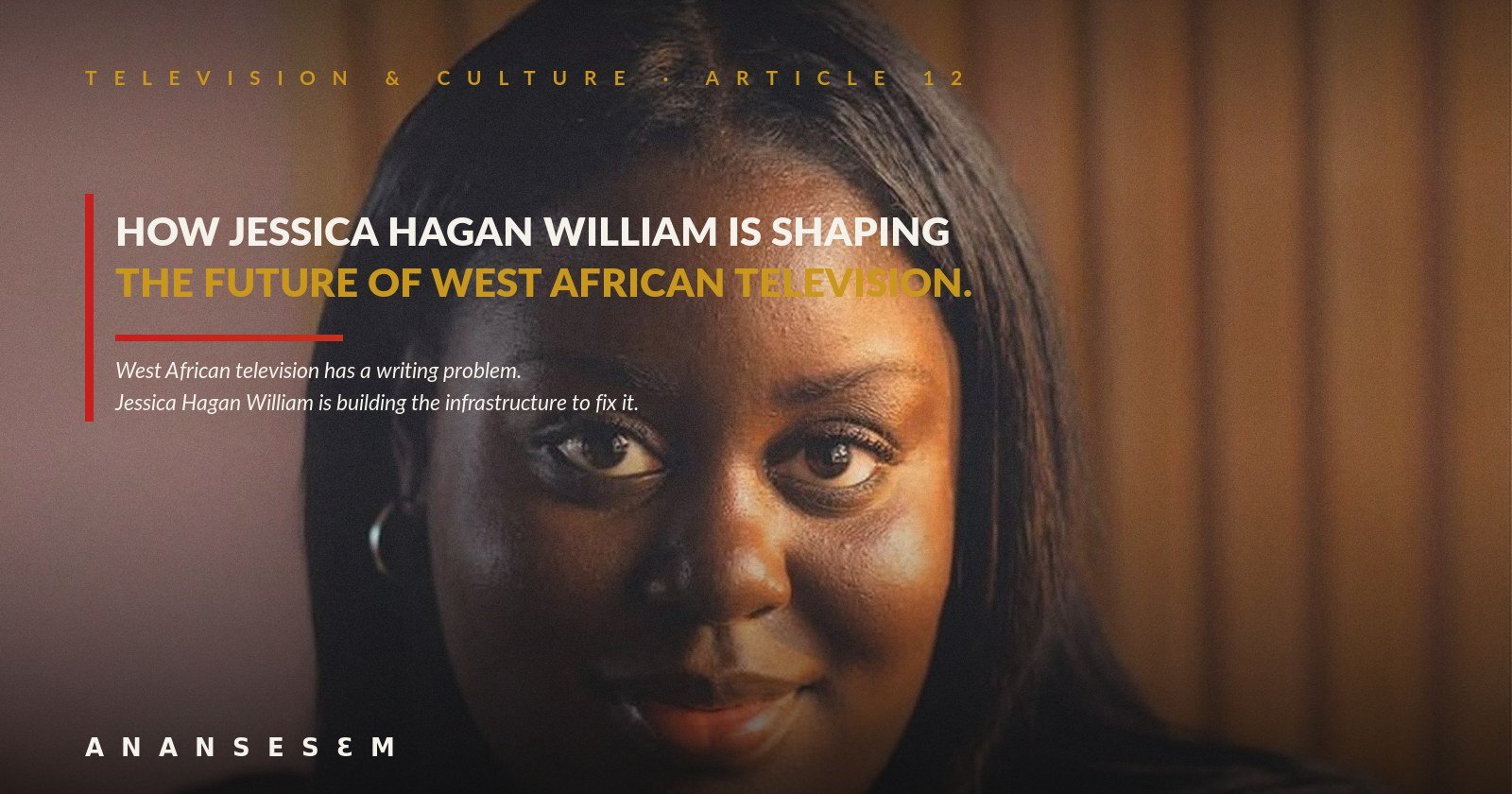
West African television has no shortage of platforms wanting content, or producers looking for the next series to option. What it has much less of is a structured way to develop the writers who are supposed to be creating that content in the first place: paid, sustained, professionally mentored development that turns a writer with a good idea into one who can actually get that idea in front of the people who finance and buy television. Jessica Hagan William has spent the last three years trying to build exactly that, in Accra, through an organization she founded called The Writers Room GH.
She didn’t arrive at that mission from the outside. She got there by going through a version of it herself.
The pitch she made herself
Jessica didn’t start in television. She started in spoken word. Her debut play, Queens of Sheba, grew out of focus groups she recorded and turned into verse, following four Black women turned away from a nightclub for being “too Black,” confronting what she calls misogynoir, the intersection of racism and sexism. It won the 2018 Untapped Award, sold out a four-week run at the Edinburgh Festival with reviews across the board, and has toured on and off since, including a run at New York’s Public Theater. Her second play, Brenda’s Got a Baby, won the Writers Guild’s National Play Commission Scheme in 2022 and was co-produced by Soho Theatre, New Diorama Theatre, and Nouveau Riche, the London company where she got her start. She has described herself, plainly, as someone who fell into writing: she studied law, worked as a web developer, then a project manager, before spoken word turned into playwriting turned into a career she hadn’t planned on.
By the time Queens of Sheba was still selling out houses, Jessica was already splitting her life between London and Accra, and thinking about screens as much as stages. In 2022, she was one of four African screenwriters, alongside writers from Kenya, Nigeria, and South Africa, selected for the AuthenticA Series Lab, a six-month development program run by the Realness Institute with Series Mania and The StoryBoard Collective. The lab put her through residencies in South Africa and Switzerland and ended, in March 2023, with her own pitch at Series Mania Forum in Lille, on the same international stage her own organization now sends other writers toward.
From a pitch in Paris to a room in Accra
Seven months later, in October 2023, Jessica was back on a stage in Paris, one of four Ghanaian creatives, alongside comic artist and filmmaker Akosua Hanson, video game studio founder Eyram Tawia, and animation director Francis Brown, sent to represent Ghana at the Forum Création Africa, the French government’s pan-African creative industries initiative. There, she pitched an idea distinct from any single script: a space in Accra dedicated to developing Ghanaian screenwriters the way the AuthenticA lab had developed her. The pitch won €30,000 in support, administered locally through the French Embassy in Ghana and Impact Hub Accra, and became The Writers Room GH.
What The Writers Room GH actually does
On its own site, The Writers Room GH states its mission plainly: to support “a healthy, diverse and thriving industry in Ghana which supports and nurtures emerging talent,” giving Ghanaian screenwriters the resources to develop their work “to a global standard.” The mechanism behind that mission is the writers’ room itself, a structured, paid, collaborative model of script development that is standard practice in the US and UK television industries and, until recently, largely absent in Ghana, where screenwriting has mostly happened alone, unpaid, and outside any institutional support.
For individual writers, the organization takes a script or an idea and works it toward something pitchable: script and pitch deck feedback, help developing a concept into a full story, and placement in paid writers’ rooms of up to six weeks at a time, writing alongside other writers rather than in isolation. From there, it tries to close a gap that has historically stopped good Ghanaian scripts from reaching anyone who could actually produce them, connecting writers directly to production companies, streamers, and broadcasters.
On the other side, the organization also works with producers and studios directly: identifying and vetting Ghanaian writing talent, running writers’ rooms of up to eight people for a production’s own project, fact- and culture-checking scripts, and providing on-set script services. It also maintains a free script library, stocked with produced scripts from shows and films made in Ghana, the UK, and the US, including titles from Netflix, HBO, and AMC, material most emerging Ghanaian writers would otherwise have no access to at all.
It is the same argument Jessica was making in 2022, a year before Création Africa was even an option for her, when she talked about wanting Ghana’s arts scene to build its own version of an industry rather than import one wholesale.
“I wouldn’t call it an industry… What I would love to see is for theatre to become a full-blown industry. What that really looks like is not taking the UK theatre industry and trying to copy and paste it here, but what does the theatre industry look like in the context of being on the continent, specifically in a place like Ghana.”
Jessica Hagan William, in a 2022 interview, on Ghana’s theatre scene
The Writers Room GH is that same instinct, redirected at television: not a shortcut to get more Ghanaian ideas in front of buyers, but an attempt to grow the writers who can actually take an idea the distance, on their own terms, without leaving Ghana or waiting for someone else’s system to make room for them.
Serial Bridges
Serial Bridges Accra is the clearest example yet of that mission operating past Ghana’s own borders. It is a workshop run by Séries Mania Institute, the training and development arm of Europe’s largest television series festival, in partnership with The Writers Room GH and the French Embassy in Ghana, under the Création Africa Ghana umbrella, part of a wider six-month program of workshops, masterclasses, and industry events. It is also the first time, in the three years since Serial Bridges launched, that Séries Mania Institute has run the workshop anywhere in Africa; previous editions have gone to Rio de Janeiro, Istanbul, and Central and East Asia.
Applications opened to writer-producer teams across ten West African countries, Ghana, Togo, Benin, Nigeria, Ivory Coast, Sierra Leone, Guinea, Senegal, Gambia, and Cameroon, closing at the end of May 2026. Each team submitted a five-page pre-bible, a logline, a season synopsis, character and arc description, a writer’s statement, and CVs, for an original season-one fiction series with, in the program’s own language, international potential. Seven teams made it through to the workshop itself: a five-day intensive that ran August 31 through September 4 in Accra, guided throughout by two mentors, Nicole Amarteifio, the Ghanaian director and screenwriter behind An African City, and Arnaud Louvet.
The workshop ended, on the last day, with each of the seven teams pitching to an audience. One of them, a Gambian series called Semester, was selected to carry its pitch further, on to Series Mania Forum 2027 in Lille. That is one outcome among several ways Serial Bridges is meant to pay off, alongside the mentorship, the market literacy, and the five days of intensive development every team received regardless of which project ultimately advanced.
What the pipeline is actually for
It would be easy to describe Jessica Hagan William as the founder of a screenwriting nonprofit that runs occasional workshops. That undersells what is actually being built. West African television has spent the last several years watching platforms and producers multiply while the writing side of the industry stays comparatively thin, short on the kind of structured, funded development that turns a working writer into one who can pitch competitively on an international stage. The Writers Room GH is a bet that the missing piece isn’t more platforms, or more funding chasing projects that are already finished, but investment further upstream, in the writers themselves, long before a project is anywhere near ready to shoot.
Serial Bridges is the clearest test of that bet so far: seven teams, from ten countries, put through five days of intensive development with mentors who have actually pitched at the level they were being prepared for. Whether that scales into something durable, a pipeline that keeps sending West African writers toward international stages year after year, rather than a single well-timed program, is still an open question. What isn’t in question is the throughline: a playwright who once said Ghana’s creative infrastructure was still being built, in real time, went and built a piece of it herself.