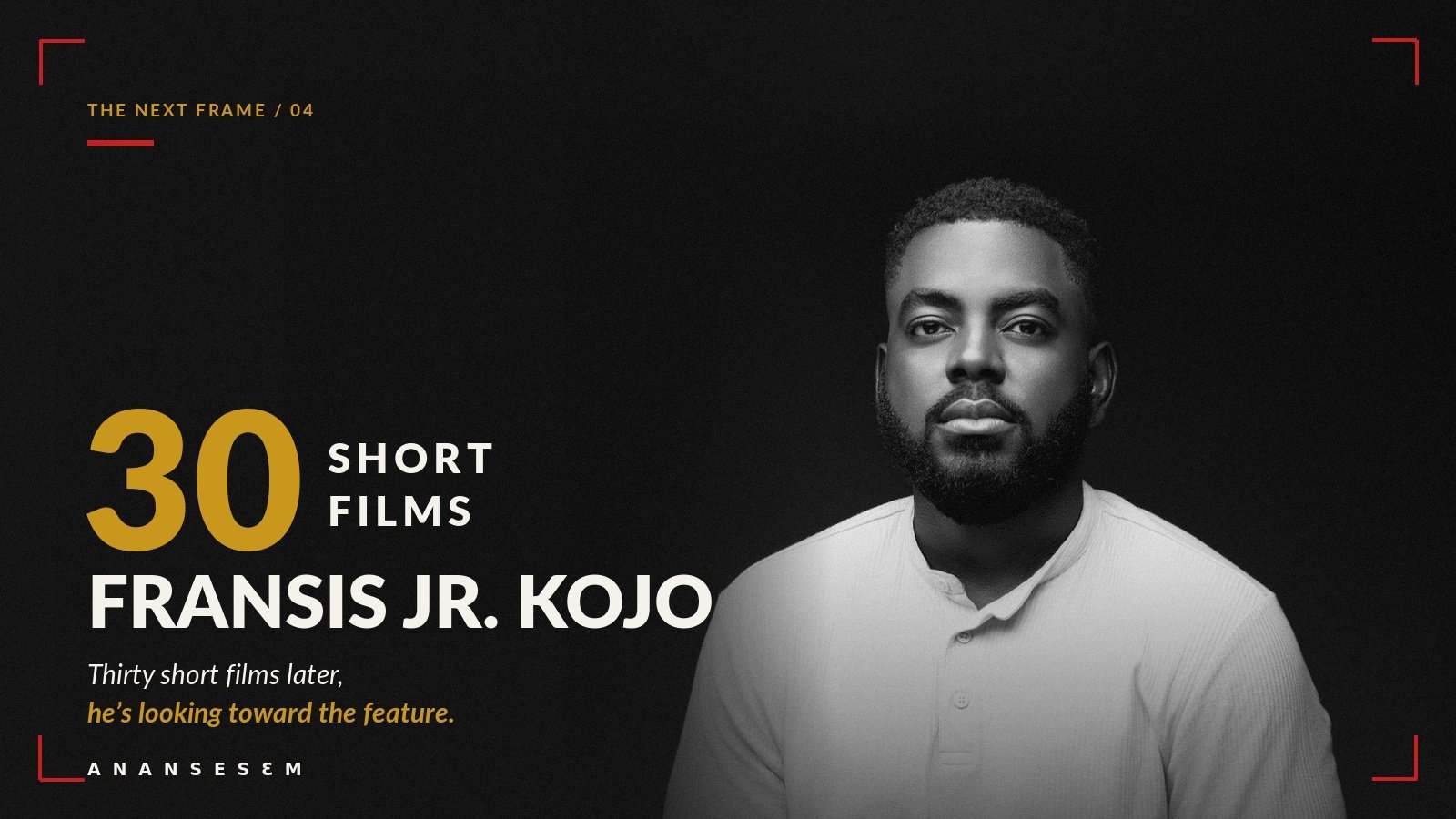
Fransis Jr. Kojo has made about thirty short films. That’s a real, substantial body of work, spanning genres, years, and the different filmmakers he’s been along the way, not a warm-up act for something else. Kojo, a Ghanaian writer and director, built his instincts inside that work: what he’s drawn to, how he tells a story, what he’s willing to spend years figuring out. Now, as he starts looking toward his first feature, this piece is about what those thirty films actually taught him, and what a feature is going to ask of him that shorts never did.
A year at home
As a kid, Kojo wanted to be an actor. He was too shy for much to come of it. Directing found him a longer way around: after secondary school he was headed for computer science, failed the entrance math exam, and spent the following year at home retaking it.
Somewhere in that year, he watched Manchester by the Sea, and something in him settled: “I was very clear on what I wanted to do with my life: to be a director.” He withdrew the computer science application and enrolled to study film directing instead.
Working through loneliness
Most of Kojo’s thirty shorts come from the years that followed. He describes himself, early on, as still finding his footing, moving between romance, thrillers, and other genres without much of a plan. What tied the work together was less genre than mood: he was dealing with loneliness at university, and it shows up across almost everything he made in that period. The work from that stretch was “almost therapeutic,” an outlet for working through loneliness.
He doesn’t describe that period as wasted time. If anything, he credits it with the storytelling instincts he works from now. As his own life changed, steadier relationships, a real support system, the stories he wanted to tell changed with it, and continue to: “As I evolve and get older, the stories I want to tell evolve too.”
Stories that don’t explain themselves
What Kojo keeps returning to now is more specific than a genre. He’s drawn to stories that behave like puzzles, where characters, and the audience alongside them, realize that what they thought they understood about the world isn’t quite right, and have to work out the truth as the story moves: “The illusion has been shattered, and, alongside the audience, they are slowly figuring out what the truth is. The film becomes a journey not just for the characters but for the audience as well.”
His latest short, Bless My Little Eyes, is close to a literal version of that method. It follows a black-market seer who sees a dead person’s final moments by taking on their eyes. Hired to investigate a young woman’s murder, he uncovers a vision that could cost him his own sight. It’s the same shape as the thing Kojo has been chasing since university: someone forced to reconstruct the truth, at real cost, in real time. The film is already available to watch on YouTube.
Learning to direct, not just to make films
For most of that early stretch, Kojo did everything himself: writing, directing, and every physical task in between. He learned from it. His own description of what it felt like doesn’t leave much to interpret: “running around like a chicken with its head cut off every time I was on set.”
The shift, when it came, was less about ambition than about function: “In order to evolve and improve as a director, you need a good team. Being a director isn’t a one man job.” He built a regular crew, people just as serious about the work as he is, each handling a specific part of production. That freed him to put his attention where he actually wanted it: “It’s now much easier for me to focus on just the story.” It’s a small, practical claim, but it marks a real change, from a filmmaker managing every task himself to one directing other people doing tasks well.
What people saw in it
If there’s a single film Kojo points to as a turning point, it’s My Memory as a Gift. Not because of any particular recognition attached to it, but because of what happened after people watched it. Viewers reached out to walk him through their own reading of the film, often landing somewhere he hadn’t anticipated: “It amazes me because they interpret it in ways I couldn’t even imagine.”
For a director whose stated interest is in stories that ask audiences to reconstruct meaning for themselves, that response is close to the point. It’s the kind of reaction he’s after: “I want to make films that get people thinking long after they finish watching.” My Memory as a Gift is the first time he felt that actually happening.
The next frame
Kojo isn’t slowing down on shorts while he prepares for something bigger. He’s already finishing a script for another short, due to start shooting in November. But the thing he’s talking about now is different in kind, not just in scale: his first feature film.
He already knows the stories he wants to tell for his first two features. He’s drawn toward thrillers set in an African context, and, notably, wouldn’t mind stepping back from writing altogether to direct someone else’s script. What he doesn’t have yet is a producer, and he’s actively looking for one: someone who “sees my vision and is just as equally passionate about storytelling.” It’s the plainest marker of where he is right now: not a filmmaker with a finished feature waiting to premiere, but one who has done enough short-form work to know what he wants to make next, and is now trying to find the people who can help him make it.
What’s outside his control
The distance between where Kojo is and where a feature would take him isn’t only creative. Every short he’s made so far, he has funded out of pocket, a familiar reality for Ghanaian filmmakers working outside a small number of larger, better-financed productions. Asked what would change the odds for filmmakers trying to build sustainable careers, his answer wasn’t about opportunity in the abstract. It was about infrastructure: more cinemas and screens, and stronger distribution networks, so that Ghanaian films could reach audiences and actually earn money once they did.
It’s a specific version of a familiar complaint, made specific by his own situation. Thirty short films is proof that Kojo can make the work. What’s less settled, and largely outside his control, is whether the systems around him can carry a feature the way they’ve carried a short.
For now, that’s roughly where he stands: thirty short films deep, clear about the kind of filmmaker he’s becoming, and still working out how to get to the film he’s actually been building toward. What that film becomes, and when, is the part of the story that hasn’t been written yet.