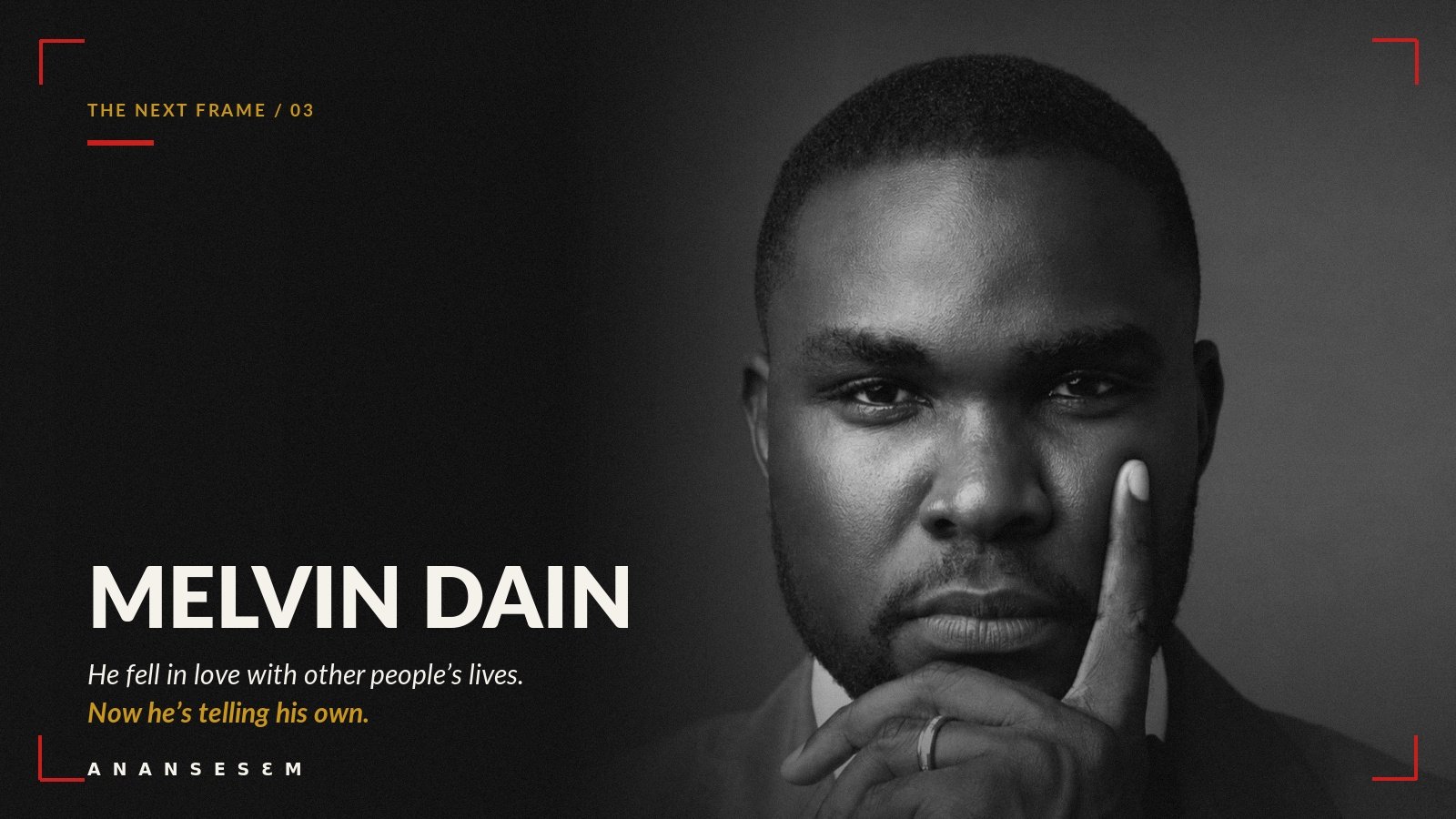
Melvin Dain trained at EbonyLife Creative Academy and has spent his career so far on both sides of the camera in Ghana, first as an actor on some of the country’s best-known productions, more recently as a director working through short films of his own. What ties the two halves of that career together is now becoming visible in his newest project: a coming-of-age story drawn directly from his own upbringing, the most personal work he has attempted yet.
A boy from the village
Dain’s path into filmmaking wasn’t planned so much as absorbed. He left his village for Accra and found himself understudying people already making films, which gave him his first real sense of what the craft involved. What actually hooked him was watching actors move between entirely different lives on screen: rich man, office worker, entrepreneur, each one a full world an actor could step into. “Coming from nothing,” he says, the idea that you could be placed into a world like that fascinated him enough to start building the skills to do it himself.
The break
As an actor, Dain has worked on Eno, a Showmax production, and House of Klu, a DStv original and Akwaaba Magic project, alongside other films and shows with some of Ghana’s best-known names. Eno is the one he points to as the actual turning point: directed by Shirley Frimpong-Manso, it changed the direction of his career and opened doors that hadn’t been open before.
Frimpong-Manso remains his biggest influence, not only for the break she gave him but for how she works: “her work ethic, discipline and approach to filmmaking are things I’m trying to bring into my own career.”
Learning to see the whole set
Dain’s move into directing runs through Plastic Man, a short documentary about plastic’s effect on Ghana’s beaches, Quiet, about a young deaf boy trying to find his place and belong, and Shadows of Ambition, his directorial debut.
Making short films, he says, revealed what actually happens behind the camera, and it was humbling. An actor can carry the assumption that being on screen makes them the most important person on set. Producing and directing corrected that: “the actor is important to the story but is not the whole filmmaking process.” What shorts gave him, more than technique, was respect for every department and every person contributing to a film.
Ordinary stories, told honestly
What Dain is drawn to now is social stories: work that can make an impact and that audiences can see themselves in, increasingly pulled toward ordinary experiences rather than dramatic ones. Time spent learning filmmaking outside Ghana widened that instinct into a fuller understanding of the process, from idea to what actually reaches an audience, rather than just the parts he happened to be closest to as an actor.
The next frame
Dain is currently developing SEDEM, a coming-of-age story pulled from his own life: growing up as a boy in the village, raised by his single mother, losing her, and then having to live with his estranged father, and the physical and emotional abuse he experienced living with his stepmother. He is keeping most of the story’s specifics close for now, but is clear about what it is: personal, and rooted directly in his own experience.
He’s looking for co-producers and co-creatives willing to join him on it, people who can bring their own perspective and experience to a story that, because it’s his, he can’t fully see from the outside.
What he thinks the industry needs
Dain doesn’t describe his own path in terms of obstacles so much as a learning process he’s still inside. What he thinks the wider industry needs is more structural: better education about the filmmaking process for young creatives, and more honest conversation about the business side of the work, how a project actually moves from paper to market, reaches an audience, earns a return, and turns that return into the next film. He also wants more collaboration among young filmmakers, ego set aside, opportunities shared rather than guarded.
What’s next
Dain calls himself a positive person, someone who treats difficulty as material to build on rather than a setback to recover from. Whether that holds for SEDEM specifically is an open question. The film asks him to do in front of an audience what he has spent his career doing for other people’s stories: hold something painful steady long enough to make sense of it. This time, the story is his own.