When Ego Reach We All, internationally titled Our Time Will Come, arrived at the 79th Locarno Film Festival this August, most of the attention went where it usually goes: to the director. Amartei Armar’s debut feature had entered Concorso Cineasti del Presente after his short TsutsuƐ became the first film from Sub-Saharan Africa selected for Cannes’ Official Short Film Competition. Then Idrissu Tontie Jr., the film’s teenage lead, won the Pardo for Best Performance, and the story became about him too.
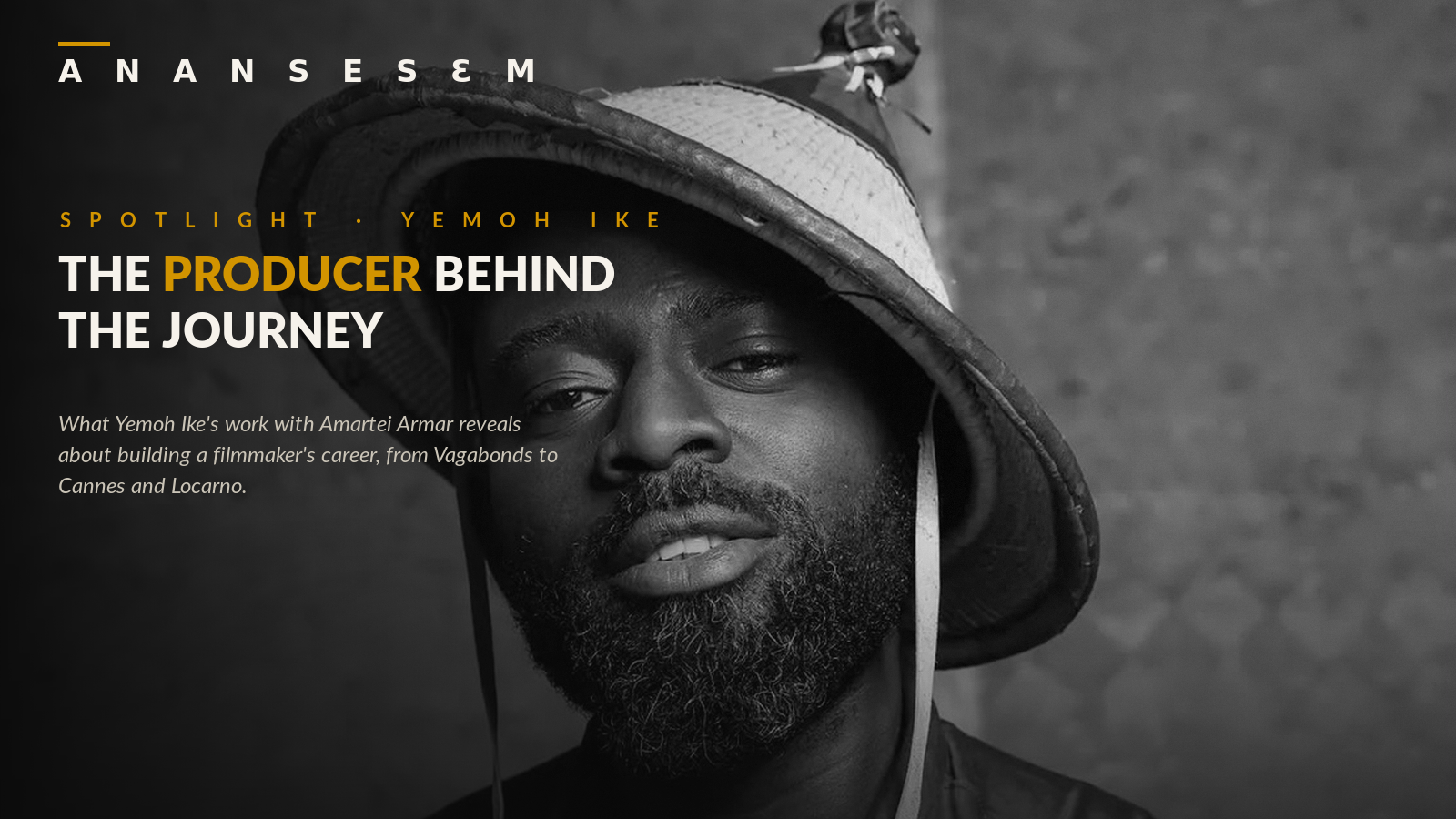
Behind both of those stories is a name that shows up in almost none of the coverage: Yemoh Ike.
Ike produced TsutsuƐ. He produced Ego Reach We All. Years earlier, he produced Vagabonds, the short film the feature eventually grew out of, and Yaa, another short they made together. That is not a single producing credit. Armar and Ike have worked on roughly five projects together: four short films and one feature, aside from commercials and music videos. It is a working relationship that has run alongside Armar’s for close to a decade, through an increasingly complicated financing map.
That raises a more interesting question than who produced this particular film: what does it mean for a producer to stay with a filmmaker for the whole journey?
From One Short to a Feature
The first thing worth examining is the timeline. Vagabonds began as a short that won at the Montreal World Film Festival, an Oscar-qualifying festival, a result significant enough to help justify developing it into something larger.
The feature that grew out of it carried the same title, Vagabonds, through most of its development and financing. It only became Ego Reach We All (Our Time Will Come) shortly before Locarno, once the film was retitled ahead of its world premiere. In between the short and the feature came TsutsuƐ, the 2022 short that reached Cannes, and Yaa, a short originally developed under the title Mmer3. Both pulled financing support from the French CNC, the state body that funds French cinema.
Idrissu Tontie Jr., who played Owusu as a child in the original short, returned years later to play the same character as a teenager in the feature. That kind of continuity across nearly a decade doesn’t happen by accident. It requires someone deciding, early, that a small project contains the beginning of something larger, and then doing the unglamorous work of keeping the relationship, and the financing, alive long enough to get there.
What a Producer Actually Builds
Producing is one of the most misunderstood jobs in independent filmmaking, particularly in conversations about African cinema. The director gives the interviews. The actors win the awards. The film gets the festival premiere. The producer is usually somewhere behind all of it: raising money, filing applications, managing schedules, negotiating contracts, building the international relationships that stand between a script and a finished film.
For a film like Armar’s, which sits outside conventional commercial financing, that work becomes even more central. The question a producer is answering isn’t only “how do we make this film.” It’s also “where can this filmmaker go next, and who needs to be in the room to get him there.”
The Financing Map Behind One Film
What it actually took to get Ego Reach We All financed is worth laying out in full, because none of it is visible on screen and all of it shaped what audiences eventually saw.
In Jeddah, the project won three separate prizes from the Red Sea Film Festival: the Red Sea Development Fund and the Red Sea Souk, both in 2022, followed by the Red Sea Production Fund in 2023, which arrived after production was already underway. Ghanaian investor ANA Ventures also backed the project financially. In 2023, Ike was also selected for the EAVE Producers Workshop, one of 56 producers chosen from 267 applicants across 51 countries, with the French CNC funding his participation through a scholarship. That year’s programme ran in three sessions, in Luxembourg, Alpbach and Rotterdam. Along the way, the project also picked up a Cannes Focus CoPro Award. In 2025, with the film still short of a completion budget, it went to the Atlas Workshops in Marrakech for post-production support.
That financing is only part of the picture. The production also had local support that never shows up on a funding line: Twellium Industrial Company kept the shoot supplied in kind, with water, drinks and snacks across 65 shoot days spread over a year.
“We raised half a million dollars over the course of the year whilst shooting.”
That was Armar, describing to Screen Daily how the budget kept growing while the project was still in production. By the time shooting started, two of the three Red Sea prizes, the Development Fund and the Souk award, were already secured; it was the Production Fund, arriving after filming was underway, that came later. Raising more of a budget mid-shoot is a director’s gamble, but it is a producer’s job to make that gamble survivable: to know which lab, which fund and which market conversation might close the gap before the money runs out. Ego Reach We All ultimately became a Ghana-France-Saudi Arabia co-production, led throughout by A.K.A Entertainment in Ghana as the main production company, with co-production partners in France and Saudi Arabia. It was shot entirely in Ghana with a Ghanaian cast and crew, finished in France, with MMM Film Sales coming on board as sales agent.
Why the Producer-Director Relationship Matters
The fact that Armar and Ike have stayed together across Vagabonds, TsutsuƐ, Yaa and the feature is, on its own, worth noting. Long-term creative partnerships are uncommon in any film industry, and rarer still in one as young as Ghana’s festival scene. Working with the same producer across multiple projects means a director doesn’t have to rebuild trust from nothing each time, and a producer doesn’t have to learn a filmmaker’s instincts under pressure. Ike and Armar built A.K.A Entertainment, their production company, around exactly that kind of continuity.
Some of that patience has a simple explanation: Ike doubles as a talent manager and personally handles casting on their projects. That is part of why an actor like Idrissu Tontie Jr. could be developed across three projects instead of being cast once and left behind.
That trust is also what makes a bigger creative risk possible, the kind Armar took when he started shooting with only half his budget secured, betting that the rest would arrive during production. It is the same pattern this publication has already traced through Idrissu Tontie Jr.’s own arc: a director willing to work with the same non-professional actor for years, and now, a producer willing to work with the same director for exactly as long.
Building Beyond One Film
In 2024, Ike joined four other producers, Yanis Gaye, Melissa Adeyemo, Carol Kioko and Chloé Ortolé, to launch Yetu (Un)Limited, a pan-African producing collective the group formed after meeting at an EAVE workshop. The idea is to pool resources and experience across each producer’s own production company rather than everyone building international relationships alone, and to pursue financing and distribution partners together across Germany, the UK, France and the MENA region.
That is a different kind of move than most producers make right after a big festival credit. Instead of treating Cannes as an endpoint, Ike treated it as an entry point into more infrastructure, a concrete answer to a question this piece keeps circling back to: what does it look like for a producer to invest in their own development, the way directors and actors are expected to invest in theirs?
The Ecosystem Question
None of this makes Ike unusual because he is the only capable Ghanaian producer. It makes him unusual because of the specific path he took to build international financing literacy, a path that ran almost entirely through institutions outside Ghana: a workshop paid for by the CNC, a co-production market at Cannes, a post-production market in Marrakech, three separate prizes in Jeddah.
That says as much about the state of Ghana’s film ecosystem as it does about Ike himself. What happens to a young Ghanaian filmmaker after a strong first short, if there is no domestic equivalent of EAVE, no local version of the Red Sea Fund, no in-country lab pipeline? Who introduces them to the next opportunity? Who teaches a producer how a co-production financing plan is actually structured, before they need €500,000 and not a year earlier?
AnansesƐm has asked a version of this question before, from a different angle: what does it mean that Ghana’s clearest festival successes keep routing through European and Gulf institutions rather than domestic ones? Ike’s career so far is one answer. For now, a Ghanaian producer builds that literacy largely by leaving: one workshop, one lab, one festival market at a time.
Give Yemoh His Flowers, But Don’t Stop There
Ike’s importance to this story may be found in something less visible than a producing credit on a festival programme. He stayed with a filmmaker long enough to watch a short film about two orphaned children become an award-winning feature, and a ten-year-old non-professional actor grow into a Locarno prize winner. He helped build the conditions for the work to travel further than either project could have travelled alone.
That model isn’t easy to reproduce. It requires patience, years of relationship-building, financing literacy most producers are never formally taught, and a willingness to invest in a filmmaker’s development long before there is any guarantee of a return.
But that may be exactly the lesson. Ghanaian cinema may not only need more films. It may need more people willing to build the careers behind those films, because sometimes a producer’s most important job isn’t getting one film made. It’s helping a filmmaker become capable of making the next one.
Are Ghana’s producers building films, or are they building filmmakers?