At the nominations announcement for this year’s Regal Film Festival and Awards (REFFA), I found myself thinking about what an event like this could become for Ghanaian cinema. There was the excitement that comes with seeing films and filmmakers recognised, of course. But what stayed with me afterwards was the effort behind the occasion and the possibility of building something that filmmakers in Ghana, and eventually across Africa, would look forward to each year. I left feeling encouraged. Here was a young institution trying to create a space for recognition, conversation and professional opportunity, and doing so from Accra.
The Africa Magic Viewers’ Choice Awards (AMVCAs) are one example of how a film awards ceremony can become a fixture in the industry calendar. Their significance comes partly from the attention that filmmakers, actors, audiences and the wider screen industry give them. Nominations become conversations. Films and performances gain visibility. People make plans to attend, follow the ceremony and celebrate the work. I would like Ghana to have an institution that can inspire that kind of anticipation over time. That is an ambition for REFFA, not a claim that it has already reached that level.
Ghana has films, performers and crews worth celebrating. It also needs consistent places where audiences can discover those films, filmmakers can meet one another and business conversations can begin. What interests me about REFFA is that its organisers appear to be thinking beyond the trophy. The awards are part of a wider festival programme that includes screenings, training, talent initiatives and a Content Market. That wider ambition deserves a closer look.
More than an awards ceremony
During the December festival, selected films from this year’s nominated and shortlisted entries are expected to screen alongside the Content Market and other industry activities, ahead of the awards ceremony. That is an important distinction. A nomination can draw attention to a title, but a screening gives audiences and fellow filmmakers an opportunity to encounter the work itself. It creates room for discussion about the filmmaking, the performances and the stories being told. It also gives the festival a life beyond the announcement of winners.
The organisers have already undertaken activities in the lead-up to December. These include masterclasses in Accra and Kumasi, promotional floats intended to draw attention to the festival, and auditions organised in collaboration with Nigerian producers. According to the account shared with Anansesɛm, some Ghanaian actors secured opportunities to work on productions in Nigeria through that process. The details of individual placements and productions would be useful to document further, but the intention is clear: REFFA is trying to connect emerging performers with working professionals and opportunities beyond Ghana.
I think those efforts matter. Running a festival that people can attend is one undertaking. Taking masterclasses to more than one city, organising auditions and building relationships across borders requires additional planning, partners and resources. It also opens different doors into the event. A young actor may first encounter REFFA through an audition. A student might attend a masterclass. An audience member might come for a screening. A producer might come looking for a distribution conversation. Each of those encounters can contribute to a lasting relationship with the institution.
The test, as the festival develops, will be how consistently these opportunities are offered and how well their outcomes are followed. It would be valuable to hear from actors who worked on Nigerian productions, filmmakers who attended the masterclasses and audiences who discovered a film through the screenings. Their experiences would help show what the festival is accomplishing between one awards night and the next.
Bringing film business to Accra
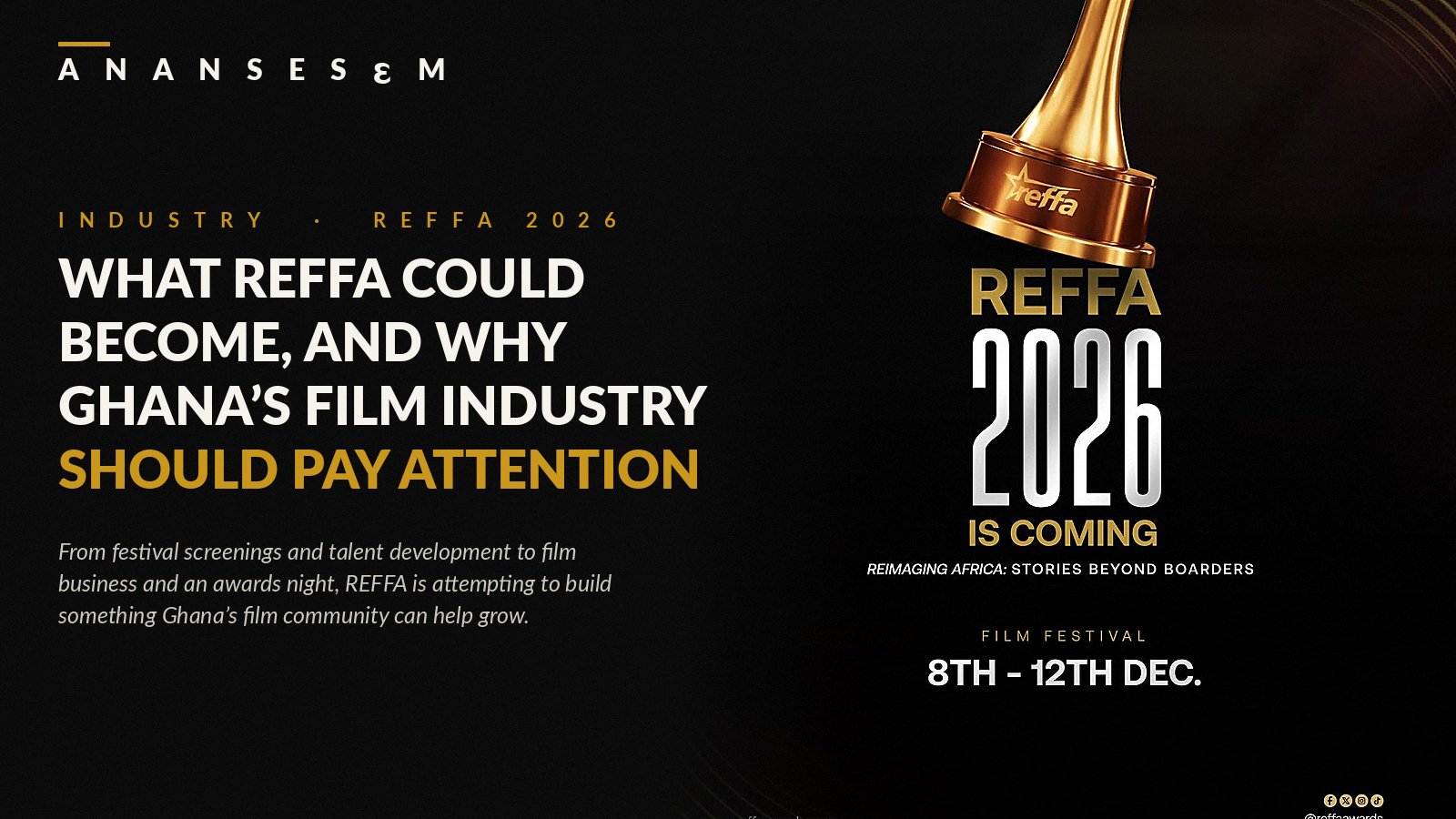
The REFFA × Blue Pictures Content Market, scheduled for 8 to 11 December at La Palm Royal Beach Hotel in Accra, adds another dimension to the festival. In responses to enquiries from Anansesɛm, the REFFA Secretariat outlined three programmes intended to create opportunities for filmmakers and companies at different stages of their work: Content Market Booths, Regal Vault and Make a Deal. The idea is to make room for the business conversations that are often difficult to access, especially for independent filmmakers who cannot regularly travel to established international markets.
The Content Market Booths are complimentary exhibition spaces for individual filmmakers, production companies, distributors and other industry professionals. Participants can present their film catalogues, trailers, posters, promotional materials and services while meeting potential collaborators and buyers. For a small company, even having a dedicated place to introduce its work and arrange meetings can be valuable. The value will depend on who attends, how well meetings are organised and whether the conversations continue after the event.
Regal Vault is designed as a three-day preview space for completed films. Rather than asking filmmakers to pitch an idea, it allows finished work to be viewed by potential distributors, broadcasters, buyers and acquisition representatives. That addresses a different challenge. Completing a film does not automatically mean it will find a route to audiences. A well-run viewing programme could help a film reach people who may otherwise never encounter it, and create a starting point for distribution discussions.
Make a Deal, scheduled for 11 December, is the pitching component. The organisers say at least six applicants will be selected for closed-door presentations to potential financing and industry partners. They have described plans to involve investors, financiers, production companies, telecommunications businesses and institutional representatives, although specific confirmed decision-makers had not been publicly identified in the information provided to Anansesɛm. For producers developing projects, a structured opportunity to explain the creative idea, the financing plan and what support they need could be useful, provided the people in the room have the ability and interest to take those conversations further.
These programmes serve different needs. One gives companies visibility, another gives completed films a chance to be seen by prospective buyers, and the third creates a setting for projects seeking partners. They are early attempts to build a marketplace, and their success should be judged by the quality of participation and what follows from it. A useful introduction, a serious follow-up meeting or a new collaboration may be a meaningful first result even where a deal is not concluded during the festival.
Why the screenings, market and awards belong together
There is a reason to consider these activities as one programme rather than separate attractions. Screenings allow audiences and industry guests to encounter films. The market gives producers and companies an opportunity to discuss how films can be financed, distributed or made with new partners. The awards then bring the community together to recognise the work. Each part can strengthen the others if the programme is carefully curated and the people taking part find value in returning.
For Ghanaian filmmakers, access is part of the appeal. Many of the industry’s most useful markets and professional networks operate outside the country. Travelling to them can be expensive, and being physically present does not always mean gaining access to the right people. A credible market in Accra could reduce some of that distance while bringing visiting professionals into contact with filmmakers working here. A festival screening a nominated film could also introduce that film to audiences who might otherwise know it only by name.
None of these outcomes should be assumed. REFFA will need strong programming, relevant industry guests, good communication and a reason for participants to return. But I think it is worth recognising the ambition of bringing these functions together in Ghana. It is the sort of infrastructure that becomes more useful when it is sustained, improved and supported over several editions.
Building on the support already taking shape
One thing I want to be careful about is how we speak about the role of Ghanaian filmmakers in all of this. There are already people attending, submitting their work, celebrating nominees and giving their time to the festival. I was at the nominations announcement myself. The point is not that Ghanaian filmmakers have failed to show up. It is that we can build on the interest and participation that already exist, and help a promising local initiative become something the wider community feels invested in.
We often discuss what Ghana’s film industry needs: stronger institutions, more consistent funding, better distribution and more places to recognise good work. Those needs are real. When people attempt to create such spaces, I think it is worth giving the effort our attention. We can attend the screenings, talk about the films, share announcements, celebrate nominees, encourage colleagues to participate and invite audiences into the conversation. Production companies and experienced filmmakers can contribute their networks and knowledge. Sponsors and other partners can help create the continuity that ambitious programming requires.
That kind of support is not the same as treating REFFA as beyond criticism. It is possible to be proud that an institution is being built in Ghana while expecting it to improve. Indeed, the more filmmakers feel a sense of ownership, the more reason they have to ask for fair judging, clear selection processes, reliable communication and meaningful opportunities. Support and scrutiny can work together when the goal is to help an institution become stronger.
I think again of the anticipation surrounding the AMVCAs. That level of attention did not come from the existence of a ceremony alone. It developed around a community of filmmakers, performers, broadcasters and audiences who came to see the event as significant. REFFA has its own identity and a different starting point, but the broader lesson is useful. An awards institution gains meaning when people trust it, participate in it and believe that the recognition matters. Ghanaian filmmakers can help nurture that culture without pretending the work is finished.
The institution REFFA could become
The scale of the organisers’ plans is worth acknowledging. Alongside a jury and an academy, they are attempting to coordinate nominations, film screenings, masterclasses, public-facing promotional activities, auditions, cross-border talent connections, a Content Market and an awards ceremony. Selassie Ibrahim and the wider team are investing effort in a young institution whose future is still being shaped. I do not think that work should go unnoticed.
But ambition also brings responsibility. If REFFA wants to become a respected platform, filmmakers need confidence in how films are selected and judged. Festival screenings should be thoughtfully programmed and accessible to the audiences they hope to reach. Market participants should know what to expect, and organisers should be able to describe who attended and what useful connections emerged. The actors and filmmakers who take part in training and auditions should have opportunities to share what those experiences led to. Over time, that evidence will be more persuasive than any promise made before an event.
I would be interested in the stories REFFA can tell after December. Did audiences discover films through the screenings? Did exhibitors meet collaborators they can work with? Were completed films introduced to relevant distributors? Did any pitching conversations lead to development meetings or partnerships? Did the actors who gained opportunities through the auditions build on that experience? Those questions are not intended to diminish the effort. They are ways of understanding how a festival can become genuinely useful to the people it serves.
What REFFA becomes in five or ten years will depend on the organisers’ consistency, the credibility of the awards, the quality of its festival and market, and the relationships it builds with filmmakers and audiences. It will also depend on whether the wider industry continues to engage with it and sees a reason to return. I hope Ghana can develop an annual occasion where our films are watched, our filmmakers meet potential partners and our achievements are celebrated with pride. REFFA is trying to create the beginnings of that space. I think we should pay attention, participate where we can and help it grow into something worthy of the confidence placed in it.