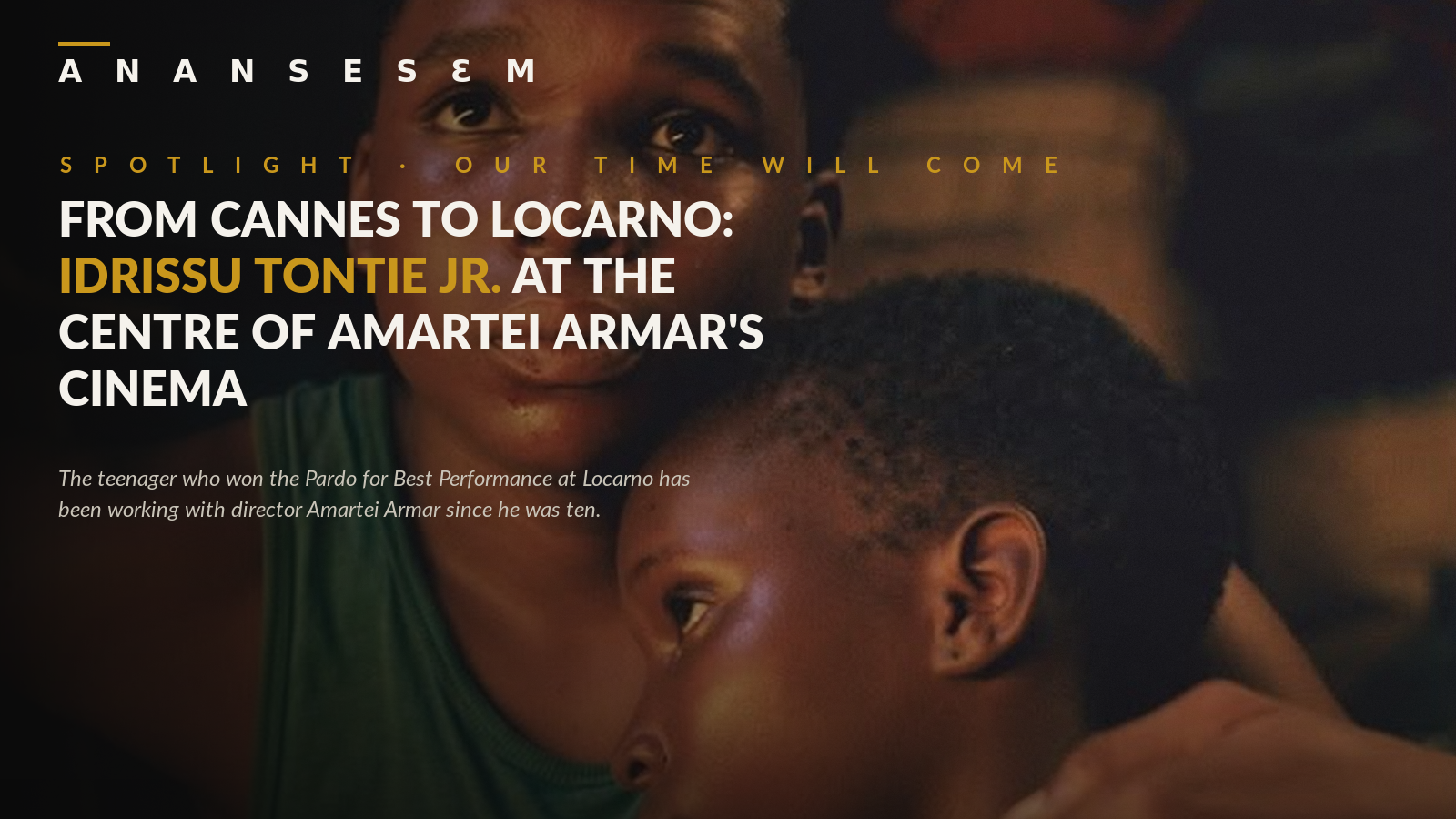
At the 79th Locarno Film Festival this August, Amartei Armar’s debut feature left with two prizes, not one. Ego Reach We All, known internationally as Our Time Will Come, won the Pardo for Change, a CHF 20,000 director’s award. And within Concorso Cineasti del Presente, the festival’s competition for first and second features, the jury gave its Pardo for Best Performance to the film’s teenage lead, Idrissu Tontie Jr. That distinction matters. The jury wasn’t applauding the whole project. It singled out one performance, in one film, and decided it was the strongest in the section.
The Pardo for Best Performance is a relatively new prize. Locarno introduced it in 2023, replacing separate best actor and best actress awards with a single, gender-neutral acting prize given across its competitive sections. It isn’t a lifetime-achievement nod or a jury’s consolation gesture. It exists to name one performance, from any film in competition, as the strongest acting the festival saw that year. A teenager from Accra, in his first feature-length lead role, just won it.
This Isn’t Where Idrissu Started With Armar
The instinct is to read this as a discovery story: an unknown young actor, plucked for a role, suddenly recognized on an international stage. That isn’t what happened. Idrissu Tontie Jr. has been in Amartei Armar’s films for nearly a decade. International audiences met him first through TsutsuƐ, the 2022 short that became the first film from Sub-Saharan Africa selected for Cannes’ Official Short Film Competition, in which he played Sowah, one of two brothers grappling with loss. That film’s cast, Idrissu included, also won the Best Acting Ensemble prize at the Indie Shorts Awards held at Cannes that year — a smaller signal, but the same kind of jury instinct that would return, at a much bigger scale, in Locarno. Armar found him even earlier, though: when Idrissu was ten years old, cast in a 2019 short also called Vagabonds — the story of two orphaned brothers, one of whom is nearly separated from the other by adoption. Idrissu played Owusu. He was cast last, on the final day of casting, after missing his own callback; the film’s producer, Yemoh Ike, happened to live across the street from his family and went to find him.
That detail is the whole story, in miniature. Our Time Will Come, the feature that just won at Locarno, wasn’t a new project inspired by that short. It grew out of it directly: the character is still named Owusu, the theme of brothers separated and reunited is still there, and the actor is still Idrissu Tontie Jr., now playing as a teenager the role he originated at ten. In between, he also appeared in TsutsuƐ. Three films, one filmmaker, one actor, spanning roughly a decade of his life. The Locarno award didn’t arrive out of nowhere. It arrived at the end of the longest working relationship Armar has had with any performer.
What Armar Saw First
Armar has been direct about why he kept returning to Idrissu — and he was already saying so before any of this had happened. Writing about the 2019 short for Directors Notes, months after casting an unknown ten-year-old off the street where his producer happened to live, Armar recalled what stood out about him at the audition:
“For his age, he was incredibly mature, introverted yet strong-willed, and his eyes had a focused intensity about them.”
He also noted that Idrissu was the second of five children who, in Armar’s words, “acts like a deputy father to his three younger siblings,” which read to him as the right temperament for a role built around protecting someone younger. Six years and two more films later, describing the feature’s casting to Screen Daily, Armar put it more simply:
“I’ve been working with Idrissu Tontie Jr, who plays Owusu, since he was 10.”
Armar has also described how he directs young, non-professional actors: not through conventional script rehearsal, but through trust built over time — hikes, go-karting, games designed to get performers reading each other’s real reactions rather than reciting lines. It is a slow, relationship-first method, and it only works if a director is willing to keep working with the same people across years, not just across projects. Idrissu is the clearest evidence that the method produces something real: a ten-year-old cast on a last-minute callback became, within one director’s filmography, a performer capable of carrying a feature and holding an international jury’s attention for doing it.
What the Review Actually Says
Variety’s review of Our Time Will Come, written by Jay Weissberg out of Locarno, singles Idrissu out specifically. It describes an “adult-sized performance” from the teenage actor and credits him with holding the film together through a significant shift in his character — from a tense, guarded protector in the film’s rural opening to a more relaxed, streetwise presence once the story moves into Accra. That is a specific, technical piece of praise, not a general compliment: it is recognition that he sustained a believable arc across two very different emotional registers, in a film built around his character’s point of view. It lines up with what the Locarno jury evidently saw as well.
A Narrower Question Than “Is Ghanaian Cinema Rising”
AnansesƐm has already made the case that Armar’s run — Cannes to Locarno, in under four years — says something about where Ghanaian festival cinema might be heading. Idrissu’s award raises a narrower, and in some ways more useful, question: where are young Ghanaian actors supposed to get the chance to do work like this? Idrissu wasn’t trained at a conservatory or scouted by an agency. He was found at a casting call held at schools and churches around Accra, cast by a director building a non-professional ensemble on trust rather than resumes, and given nearly a decade to grow into the role that eventually won him a Locarno prize. That is not a repeatable career pipeline. It is one filmmaker’s patience, applied to one actor, for ten years. If Ghana wants more performers like Idrissu Tontie Jr., the real question is whether anything in the country’s film ecosystem — training, casting infrastructure, sustained relationships between directors and young performers — is built to produce that outcome on purpose, rather than by one director’s individual practice.
What Comes Next
For now, the facts are simpler than the question. A short film shot on a modest Accra budget in 2019 put a ten-year-old in front of a camera. Seven years later, the feature it grew into put his name on a stage in Switzerland, next to a jury’s judgment that his was the best performance in the section. Idrissu Tontie Jr. is still a teenager. Whatever he does next is the part of this story nobody has written yet.