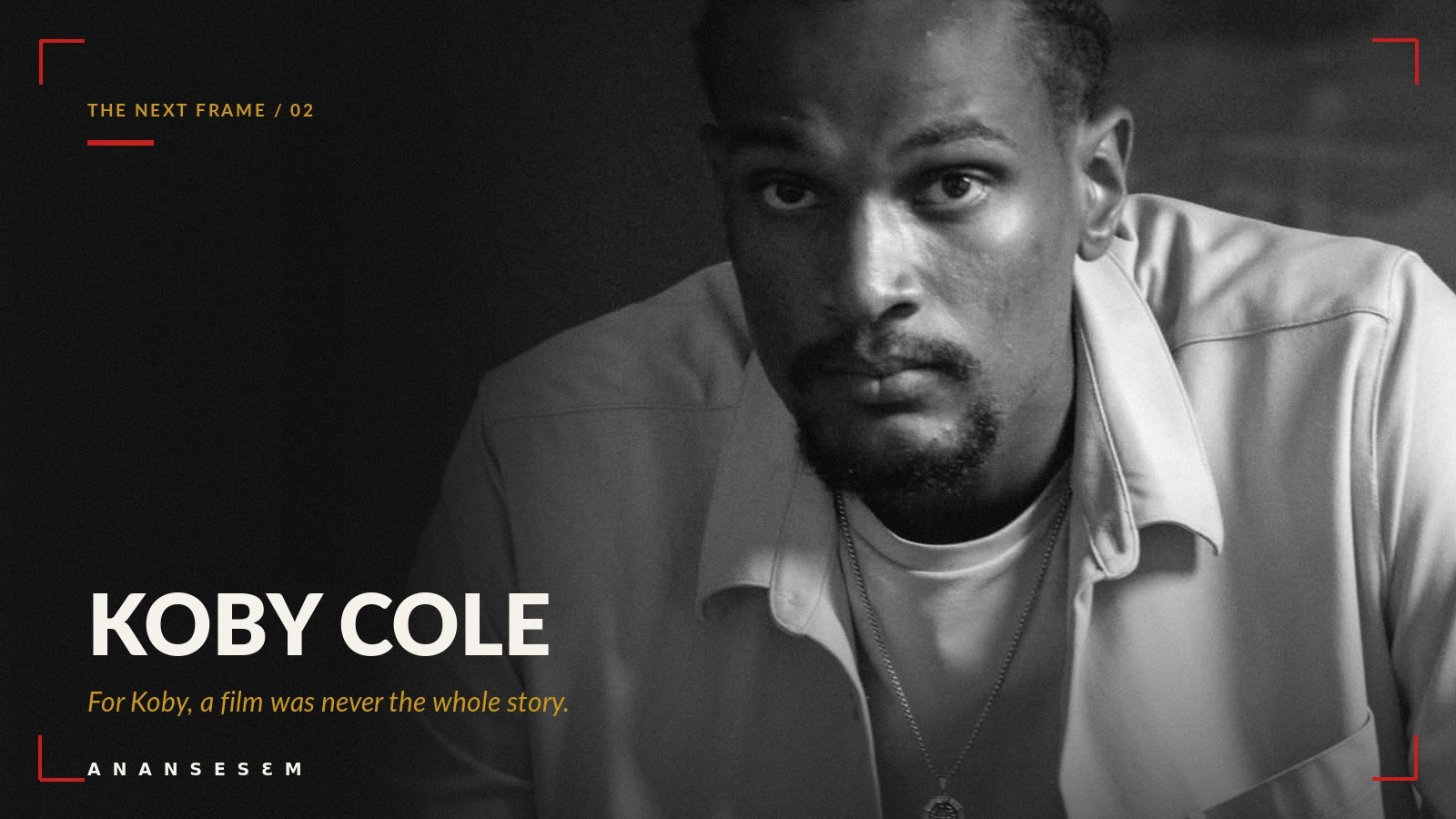
Koby Cole is a Ghanaian-British filmmaker who has been making short films since high school, about seven years now, work that started less as a filmmaking impulse than a writing one. He’d meant to become an author before a simple realization redirected him: a reader’s image of a story is limited by their own imagination, while film lets him externalize what he sees and hand it to an audience while still leaving room for their own reading. That instinct, toward building a complete world around an idea rather than a single image of it, has only gotten more literal with time, culminating most recently in a short film that came with its own album, clothing line and art exhibition attached.
Cardboard boxes and a cousin
Koby’s first three films, As the Wind Blows, Stars and Mr. Therapy, were made in high school and his first year of university: contained productions with his cousin usually the only actor, shot on smartphones, lit with DIY light boxes built from cardboard, torches, aluminium foil and baking paper. He wrote them largely on instinct, chasing whatever emotionally vulnerable idea he found interesting at the time, without much of a predetermined motive.
Growing more intentional
The two films that followed, Letters to Mon Coeur and Mother’s Smile, were more ambitious in scale, with larger casts and production teams. Letters to Mon Coeur was an experimental silent film about love and loss. Mother’s Smile explored finding hope in dark times, and became, in Koby’s account, the clearest turning point in his career so far.
His writing has grown more deliberate alongside the productions. He spends more time now with his characters, their worlds and the conflicts driving them, and has spent the years since Mother’s Smile building his skills as a director, editor and producer through commercials and promotional work.
Not a film. An ecosystem.
What changed with Mother’s Smile wasn’t just scale. It was how Koby thought about what a film could be. The project stopped reading to him as a standalone piece of work and became, in his words, “the centrepiece of a wider thematic universe”: artwork from five digital artists, an eleven-track album featuring thirteen artistes, a clothing line built with the fashion brand 1nri, and two live entertainment experiences, alongside the film itself.
“It became an ecosystem of different artistic disciplines built around one central idea,” he says. That is now how he wants to keep working, sitting deliberately at the intersection of art and business, treating a film as something that can exist as more than an object on a screen.
The builders he studies
Asked about his biggest influence, Koby doesn’t name a filmmaker first. He names history, and the people who made “a genuine dent in the universe” in their respective fields: Walt Disney and George Lucas, whom he admires less for the films they made than for the worlds, businesses and creative ecosystems they built around their ideas, and Steve Jobs, who did something similar for technology.
He is drawn more broadly to the history of cinema itself, its rises and falls, and the people who built an entire industry from nothing, a reminder that filmmaking “can also be about building something that influences culture, creates opportunities for other people, and continues to exist beyond you.”
The next frame
Koby is currently developing Mona, a micro-feature of roughly 35 minutes about a young mother who must fight for her firstborn daughter’s survival in a society that demands a firstborn son. The project is in development and intermittent pre-production, in what he calls the “grinding period,” the film developed on paper but still waiting on the money to properly begin.
He intends Mona to be the centerpiece of a wider campaign against son preference, witchcraft accusations and female infanticide, issues he says go largely unaddressed despite how common they remain in rural communities across Africa. He is actively looking for NGO partners, naming organisations like UNFPA and Amnesty International specifically, positioned to put the film in front of the audiences it needs to reach.
What he thinks is actually broken
Koby is skeptical of funding as the industry’s defining problem, since every film industry struggles to finance work with an uncertain return. What he thinks Ghana is actually missing is distribution: the systems that would let a finished film reach an audience and earn money once it does, systems that are expensive to build and easy to neglect when the market for them has shrunk as far as it has. Ghana once had a thriving cinema culture, he points out, cinemas across the country and audiences ready for anything, local, Chinese, Indian or Hollywood. That culture, in his account, has narrowed into a niche.
His answer isn’t only structural. He thinks filmmakers need to study the commercial side of the industry as seriously as the creative side, because no one else is going to do it for them.
What’s next
Koby says he’s less interested in defining exactly what his career should look like than in continuing to make work that challenges him, across film, music and art, and in finding people worth collaborating with along the way. It’s a comfortable enough position for someone who has already shown what he does with a single idea when he decides it deserves more than one medium. Mona is the next test of that instinct, this time aimed outward, at an issue rather than just an audience.